Where did we put that ice age?
Without human activity, would glaciers be advancing even now?

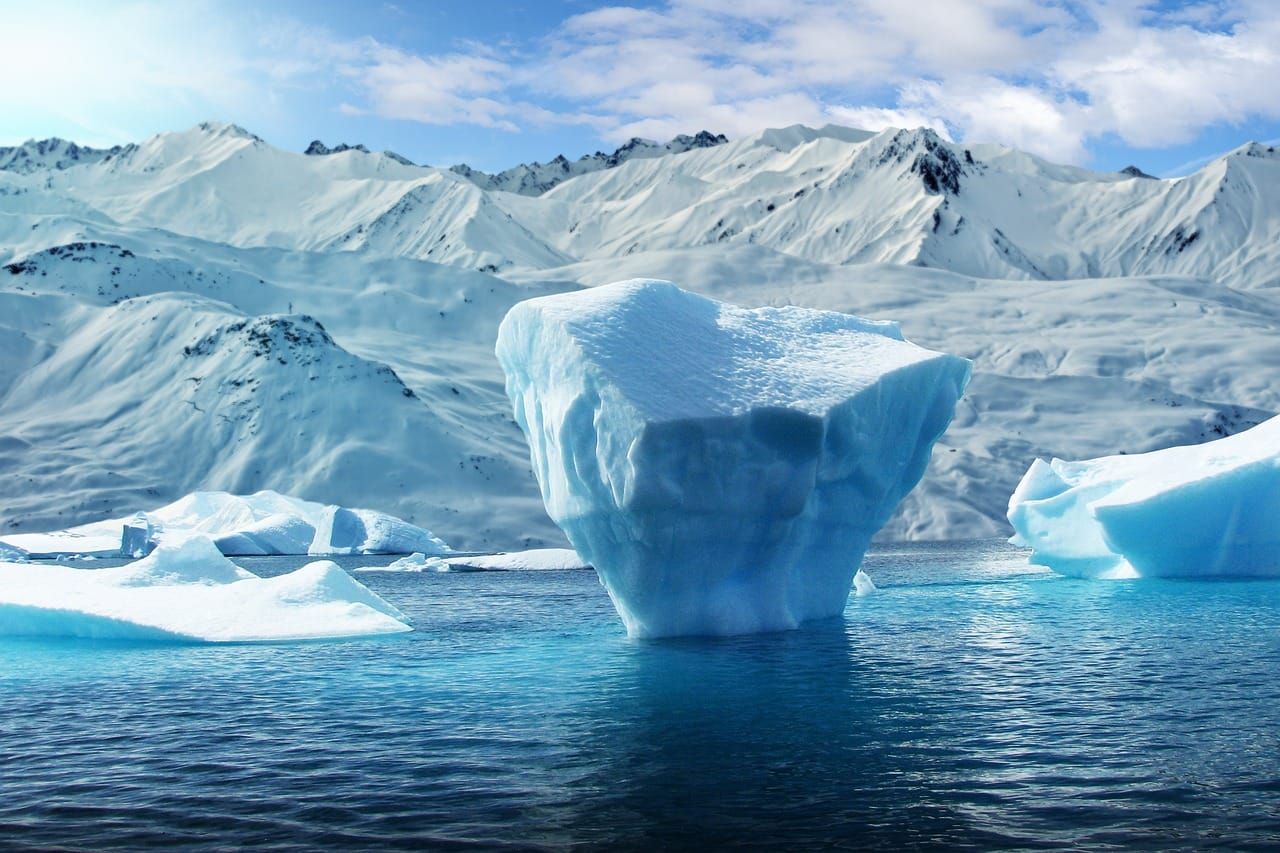
Inch by inch — line by line — with a descent only appreciable at intervals that seemed ages — down and still down it came!1
The pendulum of Earth's orbit swings back and forth, with periodic but complicated changes. Too hot. Just right. Too cold. Just right! More solar energy. Less solar energy. The glaciers go up. The glaciers come down!
But the Earth isn't a lifeless rock (well, except for perhaps in and around Oakland).2 Life — with all its florally-barfed oxygen and rotting vegetation and faunal flatulence and yeasty fermentation — has its finger on the balance of the climate scale, too. Life on Earth is common enough and prolific enough that it can buffer, bias, retard, or promote the normal astronomically-induced changes in climate.
We call all these pressures on the climate "forcing". The list of things that can force climate one way or another is pretty long. You can earn a good living out of figuring out how to put them all together into a model that makes accurate predictions.
One recent research paper by Nicolás Young (and others) looked closely at the Laurentide Ice Sheet, which once covered most of North America. (You already know about the Laurentide Ice Sheet. Those encounters Scrat had with Ice Age glaciers? That was the Laurentide Ice Sheet, right out of central casting.)
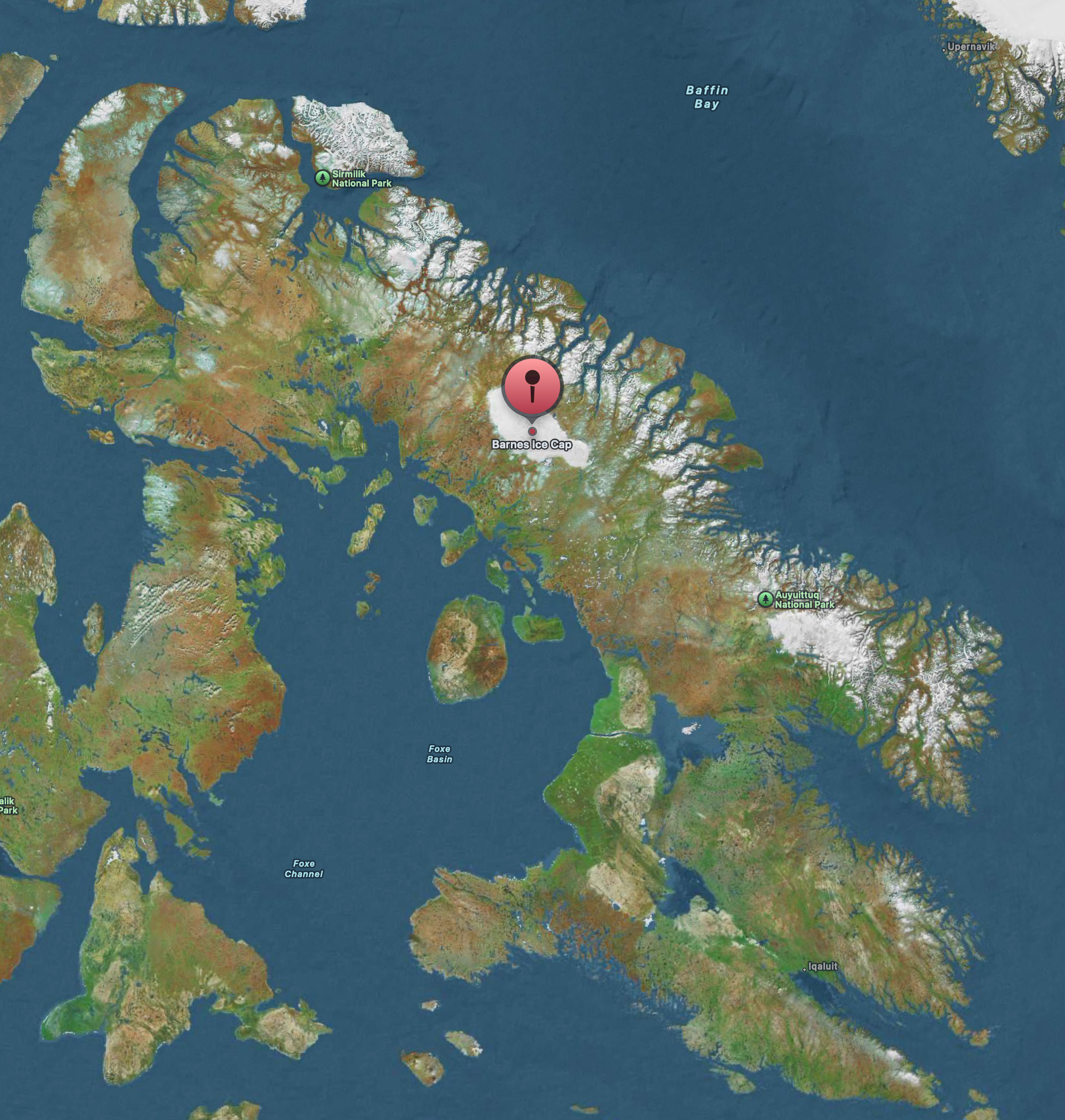
These days, the ice sheet's most-conspicuous remnant is the Barnes Ice Cap.3 When you look at a satellite map of Baffin Island, it's the big white patch right in the centre (the rib-cage of the upside-down "galloping lion" some people see as the Baffin Island outline).
Young's study was quite clever. As you probably know, most glaciers are in retreat these days. As they "back up", they leave thawing frozen ground behind ... including rocks and the remnants of plants that were frozen as the glacier advanced. Combining carbon dating of newly-thawed plants with measurement of rock-borne beryllium isotopes that react to cosmic rays when exposed, researchers were able to deduce that the Barnes Ice Cap stopped retreating about 3,600 years ago, and then, as we might expect from lower solar energy of that point in time, started to regrow about 1,600 years later.4
But Young's numbers showed the glacial advance didn't last long:
The new [ice sheet] reached maximum dimensions in ∼1960 ce, after which anthropogenic summer warming resulted in a negative mass balance, ice margin recession, and the termination of the next glaciation. The demise of the next glaciation, despite the ongoing decline in summer insolation, illustrates the influence of anomalous greenhouse gas forcing on climate.5
In other words, even though the amount of heat reaching the top of the atmosphere ("insolation": there's that astronomical geometry we were talking about) was in decline and the ice should have been advancing, human activity forced the glacier to retreat. The authors call this "the demise of the next glaciation."
Quite a large number of researchers (see "Further Reading" below) have found different ways (including ice cores) of probing the interaction between the human-generated Anthropocene and the current geological epoch, the Holocene. But Young's work has, for at least one globally significant ice sheet, given us an astonishingly precise look at the rebirth of an ice age two millennia ago and its demise in modern times at the hand of humanity.
The takeaway for us is profound. Human-induced climate change hasn't just shown up in the 21st century as heat domes and wild fires: it's been around a LOT longer than that.
Has this paper revealed that humanity has deferred an ice age? We think so.
But Young's paper was published only a month ago, in October, 2026. We'll be watching, fascinated to see how the scientific community receives it and what criticism emerges.
Reading
- Edgar Allan Poe, “The Pit and the Pendulum,” Broadway Journal 1, no. 20 (May 17, 1845): 310, https://www.eapoe.org/WORKS/tales/pitpdmb.htm.
- Gertrude Stein, Everybody's Autobiography (New York: Random House, 1937), 289.
- Lacelle, Denis, David A. Fisher, Stéphanie Coulombe, Daniel Fortier, and Roxanne Frappier. “Buried Remnants of the Laurentide Ice Sheet and Connections to Its Surface Elevation.” Scientific Reports 8 (September 2018): 13286. https://doi.org/10.1038/s41598-018-31166-2.
- “Science Magazine - Has the next Ice Age Already Come and Gone?” Accessed October 26, 2026. https://www.sciencemagazinedigital.org/sciencemagazine/library/item/22_october_2026/4368689/.
- Young, Nicolás E., Gifford H. Miller, Martha K. Raynolds, et al. “Late Holocene Reexpansion of the Laurentide Ice Sheet.” Science 394, No. 6822 (October 22, 2026): 456–59.
- Ruddiman, William F. “The Anthropogenic Greenhouse Era Began Thousands of Years Ago.” Climatic Change 61, no. 3 (2003): 261–93. https://doi.org/10.1023/B:CLIM.0000004577.17928.fa.
Further Reading
Because we can all see most glaciers in retreat, our momentary impulse is to conclude the retreat is due to climate change. The idea is incredible, especially when you realize that the Earth's position relative to the Sun indicates we should be entering another ice age. Have our activities changed the climate that much?
The papers listed below give you a chance to follow some of the most-significant work on this idea over the past 25 years.
- Broecker, Wallace S., and Thomas F. Stocker. "The Holocene Rise: Anthropogenic or Natural?" Eos, Transactions American Geophysical Union 87, no. 3 (2006): 27.
- EPICA Community Members. "Eight Glacial Cycles from an Antarctic Ice Core." Nature 429, no. 6992 (June 2004): 623–628. https://doi.org/10.1038/nature02599.
- Joos, Fortunat, S. Gerber, I. C. Prentice, B. L. Otto-Bliesner, and P. J. Valdes. "Transient Simulations of Holocene Atmospheric Carbon Dioxide and Other Tracers Using the Bern CC Model." Global Biogeochemical Cycles 18, no. 2 (2004). https://doi.org/10.1029/2003GB002156.
- Ruddiman, William F. "How Did Humans First Alter Global Climate?" Scientific American 292, no. 3 (March 2005): 46–53. https://doi.org/10.1038/scientificamerican0305-46.
- Ruddiman, William F. "The Early Anthropogenic Hypothesis: Challenges and Responses." Reviews of Geophysics 45, no. 4 (2007): RG4001. https://doi.org/10.1029/2006RG000207.
- Stanley, Sarah. "Early Agriculture Has Kept Earth Warm for Millennia." Eos 97 (January 20, 2016). https://doi.org/10.1029/2016EO043839.
- Tzedakis, P. C. "The MIS 11 - MIS 1 Analogy, Southern European Vegetation, Atmospheric Methane and the 'Early Anthropogenic Hypothesis'." Climate of the Past 6, no. 2 (2010): 131–144. https://doi.org/10.5194/cp-6-131-2010.
- Zalasiewicz, Jan, Colin N. Waters, Erle C. Ellis, et al. "The Anthropocene: Comparing Its Meaning in Geology (Chronostratigraphy) with Conceptual Approaches Arising in Other Disciplines." Earth's Future 9, no. 3 (2021). https://doi.org/10.1029/2020EF001896.