A Wildfire Pilot Log
A guest piece from TopCat, a chopper pilot with 20,000 hours in the air and hairy tales to tell about fighting wilderness fires.
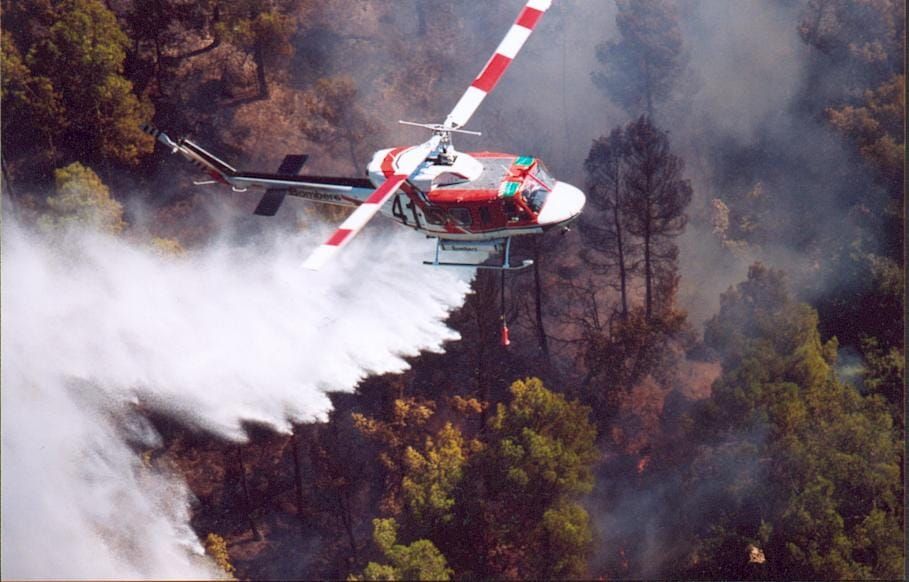
I was a helicopter pilot for many years. It was a career with many highlights, but I enjoyed fighting wildfires the most. In a world where avoiding danger is often the priority, working a wildfire with a helicopter offers a visceral thrill few will ever experience.
Most natural fires are more "mild" than "wild." Mostly they'll creep along the ground following the fuel until conditions change. The fuel thins out, the humidity rises or the wind drops off. They run out of inertia and die.
However, when prolonged heat, heavy fuel, low humidity, and strong wind combine with an ignition source, a modest fire can very quickly become a force of nature, well beyond the limits of human intervention.
In 1985, I was working a fire in the Taleomey River valley south of Bella Coola, British Columbia, Canada. The ignition source was a cable's friction over a deadfall while logging heavy timber on a dry south-facing slope. All four factors mentioned earlier were present, and the fire was quickly out of control.
However, after several weeks of hard, dirty work by hundreds of firefighters and dozens of aircraft — and aided in no small part by a spell of cool, cloudy weather – I was piloting the sole helicopter remaining. It's called the "mop-up stage."
I was supporting a small crew working a hotspot deep in a rocky talus slope. My job was to drop water on embers they'd exposed. No smoke. No open flames. No sense of urgency.
I was halfway through a lunch sandwich when an urgent radio call came in from the hill. Moments later, I was airborne and saw the situation had changed. The wind had picked up, the hotspot's embers had flared up, some nearby grass caught fire and flames soon jumped into the lower branches of conifers.
As the saying goes, the fire had "picked up her skirts and started to run." It was spreading upslope and downwind faster than I would have thought possible.
In a rush of flame and smoke, old-growth trees that had stood tall for hundreds of years were immolated in seconds, the flames soaring twice, three times higher than the treetops. When the heat is this intense it's not sparks anymore, but radiant heat igniting the trees in its path. A massive column of smoke and ash — a pyrocumulus cloud — mushroomed skyward, driven by gale-force thermal winds as the fire vacuumed up the oxygen. We had gone from mop-up to emergency crew evacuation in less than fifteen minutes.
Earlier in the day, I had dropped off a half-dozen loggers to recover a D7 Cat. The machine was bogged down in a natural cul-de-sac around the corner and up a narrow canyon, a kilometre or so from the fire. But with my mop-up crews safely back in camp and the fire growing in size and power exponentially, it was time to go, boys. As I turned the corner I saw they were completely focused on their work, oblivious to what was bearing down on them.
Landing on a road in near-darkness about 50 metres away, the helicopter's arrival went unnoticed and it wasn't until I got their attention by hovering a few feet above them that they looked up and saw the danger, dropped tools and ran.
Back to the road I waited, powered up, light on the skids, with my door off to improve visibility. Borne aloft by the thermal gale, burning branches started to fall out of the smoke and into the grass, starting new fires as I watched. And the sound! Like a thousand freight trains, the roar of the oncoming inferno easily overcame the noise of the helicopter.
The men ran toward me like their tails were on fire and as they piled in I lifted, turned, and pulled away as if MY tail were on fire! I hunched my shoulder as I felt the skin on the side of my face tighten from the heat. I remember checking my gauges for signs the superheated air was affecting the engine: a failure now would be bad.
It seemed like an age before we pulled out into clear air and blue sky and we all breathed a sigh of relief. A couple of guys laughed hysterically. I turned the machine to look back. Our "cove" now looked like something you'd see deep in the coals of a late night campfire: cherry red.
Forty-one years have passed and I’ve worked on many big fires, but nothing has come close to the sense of awe and humility I felt on that day in the Taleomey River valley.
TopCat retired to a small island off Canada’s West Coast after flying helicopters for over 40 years. Heliskiing in the Himalayas, VVIP flights in the UAE, bush pilot in NW BC, air ambulance in Saudi Arabia, and other adventures too numerous to mention. He’s out with his camera most days now, capturing the natural beauty that surrounds him.
Reading
For information on historical stats for Canadian fires for the past 25 years, scroll down to heading H at https://ciffc.net/situation/2026-09-29.