How much water do data centres use?
All data centres together use about as much water as a very large city.

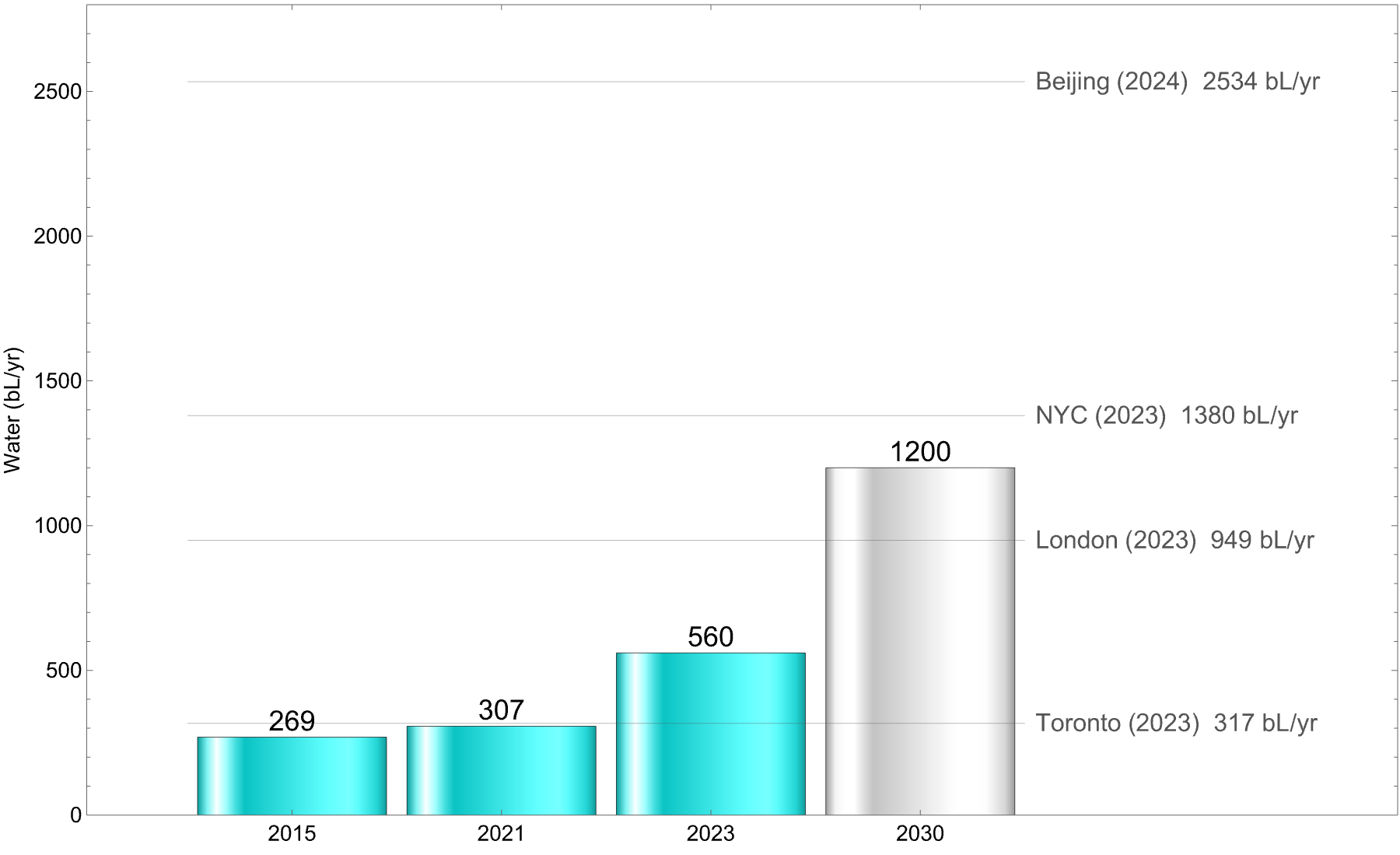
If predictions are correct, by 2030 data centres worldwide will need about a trillion litres of water each year. That sounds like a lot ... and it is!
What else uses a trillion litres a year of water? New York City. London.
So, you could accurately say that all the data centres we are likely to create in the next four years — by 2030 — would put data-centre water consumption at the same level as a major world-class city.
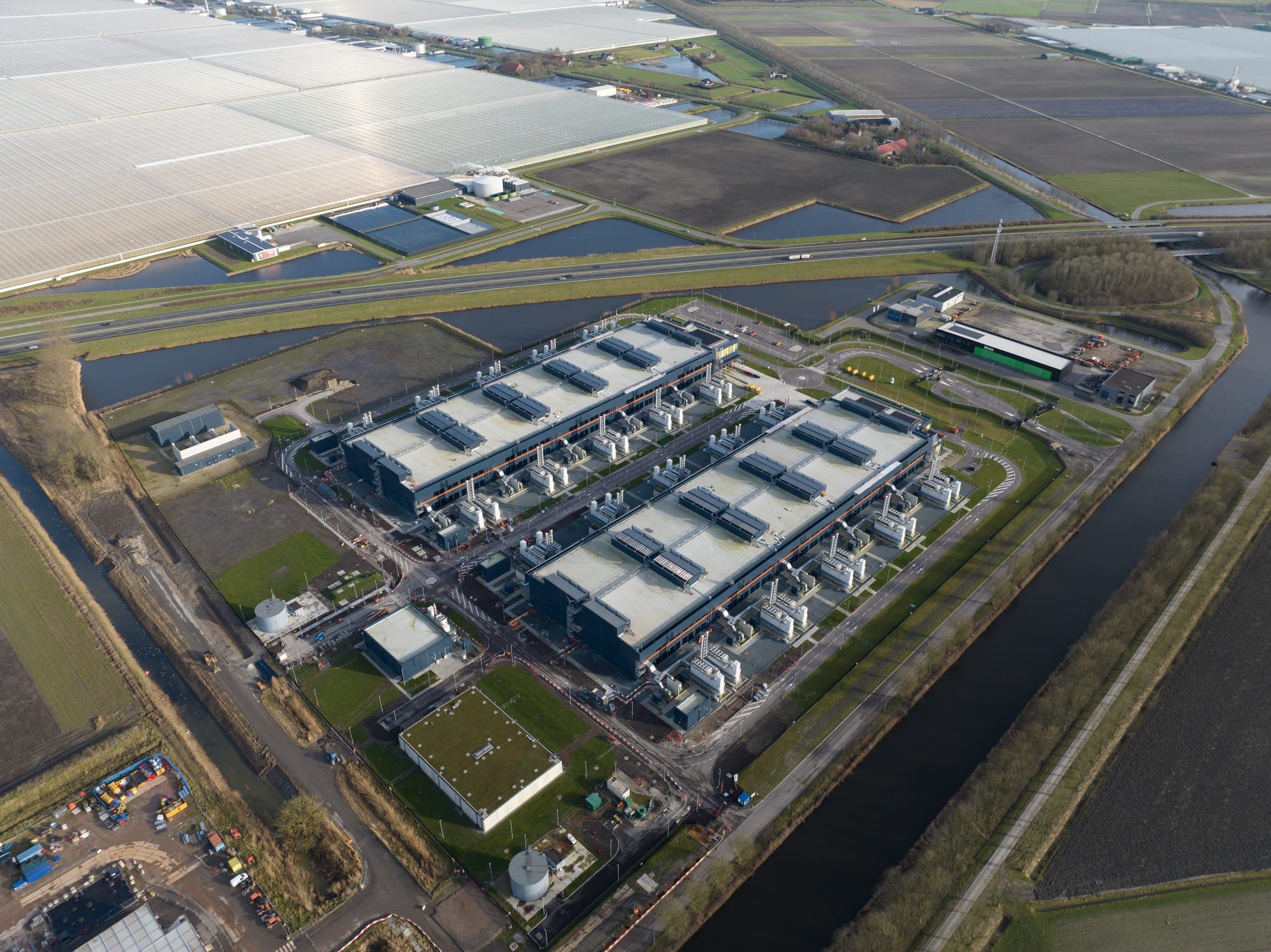
Just as global data-centre water consumption compares to a large global city, a local data centre's consumption can compare to that of a local city. A single data centre can easily be the largest customer of a municipal water plant.
Water and data
If you have an image in your mind of a data centre hooked up to a giant water main, sucking up cool fresh water and then spitting it out into the sewer ... well, in some cases that's partly true, but the reality is broader and more nuanced.
First off, not all data centres are huge. About 40% of information technology processing happens in spare offices, closets, and basements, where one or two computers do their work without using water directly. Typically, these small computer facilities are air-cooled. But together they are still a lot of computers, with power requirements of about 13 billion kilowatt-hours a year.1
While most large data centres use water directly for cooling, they also can use water indirectly, mostly because they consume so much power. Power also often needs water (think about the cooling requirements of a natural gas power station). In some circumstances, power requirements can account for up to 60% of the water use attributed to large data centres. Even small data centres may indirectly increase the water needs in an area, depending on the form of power generation.2
Although most data-centre water is diverted from potable water systems, a very small number of facilities use other water sources: lakes, rivers, the ocean, or rainfall catchment.
Cooling water may be circulated through chillers and cooling towers, warmed and re-cooled several times until much of it — up to 60% — has evaporated, when the remnants, which are generally no longer fit for domestic use, are returned to the water cycle.
The water is not lost so much as it is re-distributed, back to the atmosphere as vapour and to bodies of water in its liquid form.
Path forward
While computers don't necessarily need to be liquid-cooled, air cooling is less efficient. It uses about 10% more energy, and therefore generally emits about 10% more carbon.3 Some data centres are designed to be wholly or partially air-chilled, while some use energy sources that don't emit carbon and use much less water. In fact, solar and battery power can be the fastest-to-build power source for hurried investors who want to create data centres. Happily, this can also eliminate much of the indirect water needed for power.4
You wouldn't be wrong to see this as a trend to be watched.
As populations grow, as industrial activity expands, and as climates change, water scarcity will be an ever-important issue. Today's data centres tend to increase demand on supplies of processed and potable water, sometimes in areas where water scarcity or cost matters. At the very least, their sudden advent certainly changes water distribution patterns and requires different approaches in a warming, data-hungry world.
Reading
General
- Ganeshalingam, M., A. Shehabi, and L. B. Desroches. Shining a Light on Small Data Centers in the U.S. June 30, 2017. https://escholarship.org/uc/item/8dh8j3kq.
- Mytton, David. “Data Centre Water Consumption.” Npj Clean Water 4, no. 1 (2021): 11. https://doi.org/10.1038/s41545-021-00101-w.
- Felder, Linden. “Data Center Water Consumption: AI Uses More Water Than Entire Cities.” SENTINEL EARTH, March 5, 2026. https://www.sentinelearth.com/post/data-centers-now-drink-more-water-than-entire-cities.
- Mossburg, Landon, cited in Semafor Energy, Saturday, June 13, 2026.
- Evaporative vs. Dry Cooling: A Complete Industrial Guide - New Cooling Tower Construction, Parts, Maintenance, Upgrades. Blog. November 3, 2025. https://h2ocooling.com/evaporative-vs-dry-cooling/.
Numbers in the chart
2015 and 2021: Zhang, Coco, Jan Frederik Slijkerman, and Diederik Stadig. “Growth in Water Consumption of Data Centres Needs More Attention.” ING Think – Economic and Financial Analysis, October 24, 2023. ING Bank N.V.
2023: Siddik, Md Abu Bakar, Arman Shehabi, and Landon Marston. “The Environmental Footprint of Data Centers in the United States.” Environmental Research Letters 16, no. 6 (2021): 064017. https://doi.org/10.1088/1748-9326/abfba1 plus Felder (as below)
2030: Felder, Linden. “Data Center Water Consumption: AI Uses More Water Than Entire Cities.” SENTINEL EARTH, March 5, 2026. https://www.sentinelearth.com/post/data-centers-now-drink-more-water-than-entire-cities.
Toronto: City of Toronto. “Daily Water Consumption Report.” Toronto.ca, accessed May 2026.
London: Greater London Authority. “Water Resources.” London.gov.uk, June 29, 2023.
NYC: New York City Department of Environmental Protection. “History of Drought & Water Consumption.” NYC.gov, accessed May 2026, and “Water Consumption in the City of New York.” NYC Open Data dataset, City of New York, last updated May 21, 2025.
Beijing: “Beijing’s Water‑Use Efficiency of 2024 Ranks First in China.” Beijing Daily (English edition via english.beijing.gov.cn), February 16, 2025.