Methane: Still messing up the planet AGAIN
The first SweetLightning article was about methane ... and how it's messing up the planet. Methane use is increasing. So we're going to mention it again.

According to a report from Standard and Poors Global on July 16th, 2026, a winner in global geopolitical conflicts has emerged: US natural gas exports. From export and domestic uses, US feedgas demand is expected to double in the next five years.1
Of course, methane comes from many sources. It emerges from leaky pipelines and oil and gas wells, but also from landfills and swamps, from cows and pigs and ponies and people. It's common because it is made from carbon and hydrogen ... and so is every living thing. You want life? Sure, but you gotta sign up for regular methane deliveries to get it.
Some emissions are indigenous, coming from processes largely related to living creatures. Agriculture contributes significantly to methane. So does disposal of organic waste. Some bio-source methane is a "heritage" gift from the past: it has been captured in permafrost or other forms of storage, and is gradually released as the climate warms. Almost all natural gas is biogenic in origin, even though some of it is very old.
Of course, we need to address all forms of methane from all sources ... but our own emissions are the easiest place to start, in part because they are volitional and under our control. The petroleum industry's emissions are substantial, and it's easier to change a pipeline compressor seal than it is to get swamps to stop burping. The coming surge in natural gas for heating and for electrical generation (in large part driven by the huge investment in data centres) promises to make the problem worse quite rapidly.
Natural gas is about 85% methane. When burned, it produces carbon dioxide in the same way as any fossil fuel. But, as a gas, methane must be acquired, stored, and transported before it can be used to emit carbon dioxide. In all that activity, natural gas itself leaks from all the distributed apparatus of the industry. When it goes into the atmosphere as methane, natural gas creates a serious problem.
Methane's ability to trap heat in our atmosphere is spectacular: in its first year, a tonne of methane will trap 120 times more heat than a tonne of carbon dioxide. The Intergovernmental Panel on Climate Change (IPCC) has decided the long-term effect is more important, so they use a factor of 28 times the CO2 warming after 100 years, even though the methane is effectively dissipated after about a decade. That should give you some idea of how seriously bad it is: methane can quit after 10 years and let CO2 warm the planet for another 90 years ... and methane still traps 28 times as much heat.2
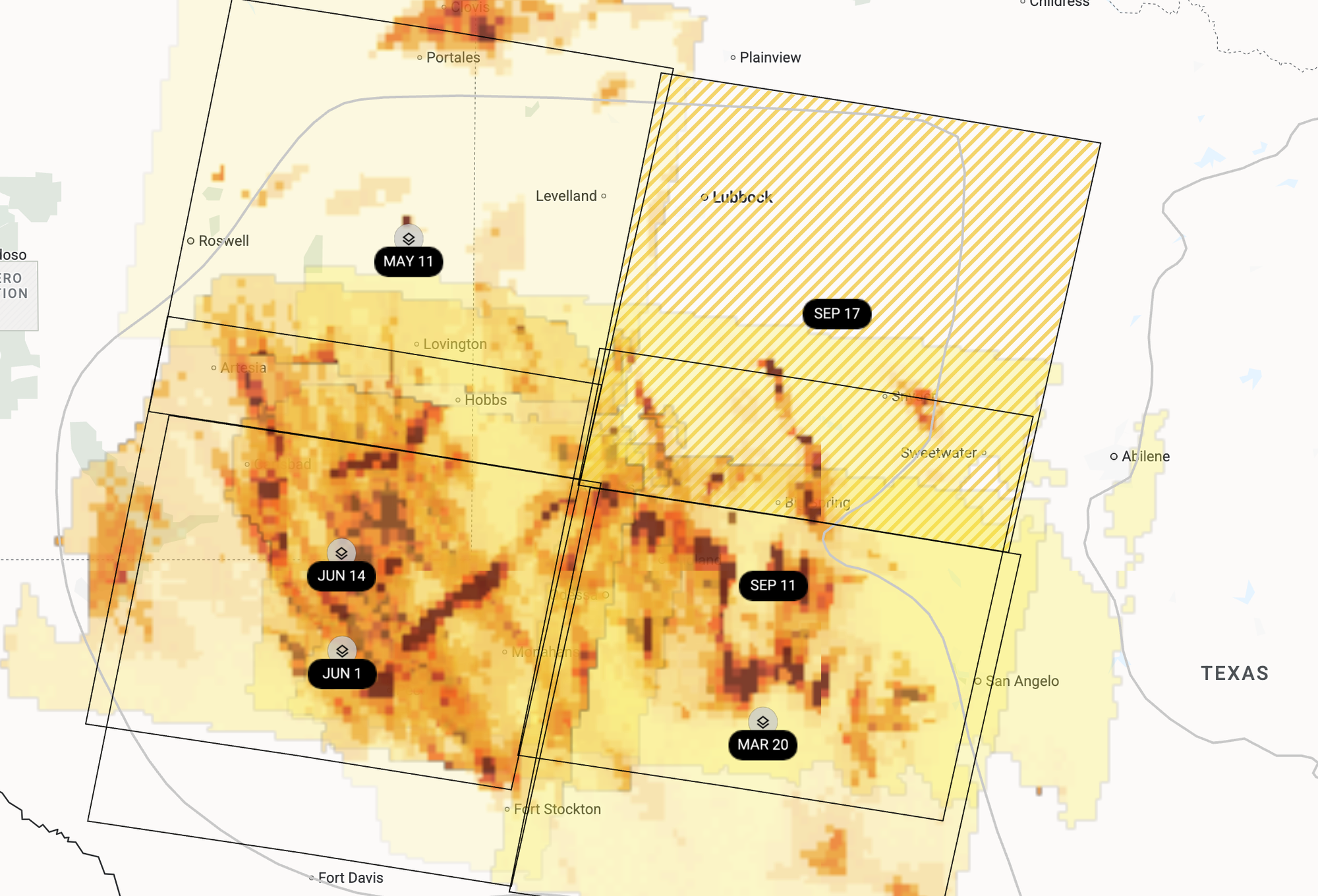
Methane emissions are tough to measure. If you are looking for a possible methane leak, you can’t detect it easily – in part because the gas is lighter than air and transparent – unless you have a monitor downwind or above a source. After a while, methane mixes with the atmosphere, where it will — as we said up above — take about 10 years to degrade into other compounds. Because of these difficulties, we're beginning to use satellites, airplanes, and drones to look down and actually measure the emitted methane … sometimes right as it is emitted, but also after it becomes an ambient component of the atmosphere. An exciting new generation of sensors makes highly-accurate fly-over detection possible.3
Since the middle of the last century, petroleum-industry methane management has largely depended on bottom-up models rather than on actual measurements. These models are actually quite ingenious. For example:
- For each type of component in a methane facility, estimate the amount it should leak
- Multiply by the number of components
- Add it all together, and you'll have a rough idea of the amount of methane released
"Rough" is the right word, though. Lots more leaks were happening in pipelines, wells, and compressor stations than the engineering models predicted. Mostly, these leaks were transient: random and unpredictable. Whenever actual direct measurements could be made (not impossible, just difficult and expensive), the models were way off.4
And yet, until recently, this is how the petroleum industry has reported methane emissions to national governments and to the UN's IPCC. The approach didn't work all that well, and the industry was not powerfully motivated to improve it. As the New York Times reported in an article on July 22, 2026, "The oil and gas industry has known for decades that its wells were releasing far more planet-warming methane than companies acknowledged, according to industry documents identified by an environmental group."5
Now, new models integrate top-down methane emissions measurements with bottom-up engineering-driven estimates. This is a lot more accurate, but still has shortcomings. A lot of methane emissions are transient: they come and go without warning. A methane satellite can be on the other side of the world at the moment an emission happens. Or an airplane doing the measuring can be 20 kilometres away. Or a drone can be flying over a different facility.
Also remember that methane in the atmosphere can move sideways as it is blown around by weather systems, crossing national and continental borders. A gas such as methane will always expand to distribute itself as evenly as possible in any volume of air ... even if that volume is the entire atmosphere of our planet. So in many cases, we can measure the result of all our methane emissions, but the detective work to discover the exact sources can sometimes still be difficult.
Emissions we don't see — because we aren't looking or because they have come from somewhere else — won't be specifically counted as emissions from any particular country, so they won't get reported that way to the official inventory. But they will still be detectable to surveys of the ambient methane level over a broad geographic region.
Because methane lasts for about ten years in the atmosphere, we should see a time lag between when methane emissions drop and when atmospheric methane starts to go down. The only way ambient methane will drop is if more methane “ages out” than is released. We haven't reached that point yet.
This is troubling. But it creates a huge opportunity.
We can believe we are reducing methane, but the problem can still be getting worse. On the other hand, we know the carbon-industrial society we've built is going to take some time to turn around. If we apply the brakes to carbon-generating processes HARD and NOW, it's not going to be fast enough. Methane's easier to stop. It can give us time to sort out our toxic relationship with carbon.
This will be challenging. At the same time as we are certainly still underestimating emissions from the energy industry, natural gas production is being driven upward by political and economic considerations. Measurement is critical here: we must continue to refine our models and measurements for all emitting sources, both indigenous and industrial, and use this in policy guidelines and action plans. In particular, we need to address all forms of leaks from natural gas production, transport, and use: these emissions are deadly.
Right now, when we're not looking, methane goes undetected. The S&P report typifies the attitude of investors towards natural gas as an environmental hazard: the word "climate" appears only once in their 48-page report ... in the disclaimer. It does not appear in the "Impact" or "Key Takeaway" sections.
In other words, the climate is external to all the truly important questions.
Think about that at three in the morning.
Reading
- S&P Global. “Price and Economic Impacts of an Accelerating Export Industry: US LNG Impact Study – Phase 4.” July 16, 2026.
- Balcombe, Paul, Jamie F. Speirs, Nigel P. Brandon, and Adam D. Hawkes. “Methane Emissions: Choosing the Right Climate Metric and Time Horizon.” Environmental Science: Processes & Impacts 20, no. 10 (October 17, 2018): 1323–39. https://doi.org/10.1039/C8EM00414E.
- Erland, Broghan M., Andrew K. Thorpe, and John A. Gamon. “Recent Advances Toward Transparent Methane Emissions Monitoring: A Review.” Environmental Science & Technology 56, no. 23 (December 6, 2022): 16567–81. https://doi.org/10.1021/acs.est.2c02136.
- MacKay, Katlyn, Martin Lavoie, Evelise Bourlon, Emmaline Atherton, Elizabeth O’Connell, Jennifer Baillie, Chelsea Fougère, and David Risk. “Methane Emissions from Upstream Oil and Gas Production in Canada Are Underestimated.” Scientific Reports 11, no. 1 (April 13, 2021): 8041. https://doi.org/10.1038/s41598-021-87610-3.
- Tabuchi, Hiroko. “Oil Firms Knew for Decades of Methane’s Danger to Planet, Documents Suggest.” Climate. The New York Times, July 21, 2026. Paywall: https://www.nytimes.com/2026/07/21/climate/methane-natural-gas-leaks-flaring.html
The Methane Map
The lead image in this article is taken from an image generated by the public tools found at: LLC, MethaneSAT. “Methane Emissions Map.” MethaneSAT. Accessed July 22, 2026. https://portal.methanesat.org/en/emissions-map?view-latitude=32.44627&view-longitude=-102.32828&view-zoom=6.80&date=2025-06-30&platform=MethaneSAT&product=l4&color-scale=msat_warm_default.