Electrification Staircase
Where to focus electrification efforts? This tool helps.
About a year ago, we wrote an article that argued efficiency gains from electrifying nearly everything in the economy would have a huge de-carbonizing effect. We wrote “. . . efficiency gains from electrification of nearly everything would result in a 40% reduction in final energy demand.”
Easy to say, but of course much harder and more complex to do.
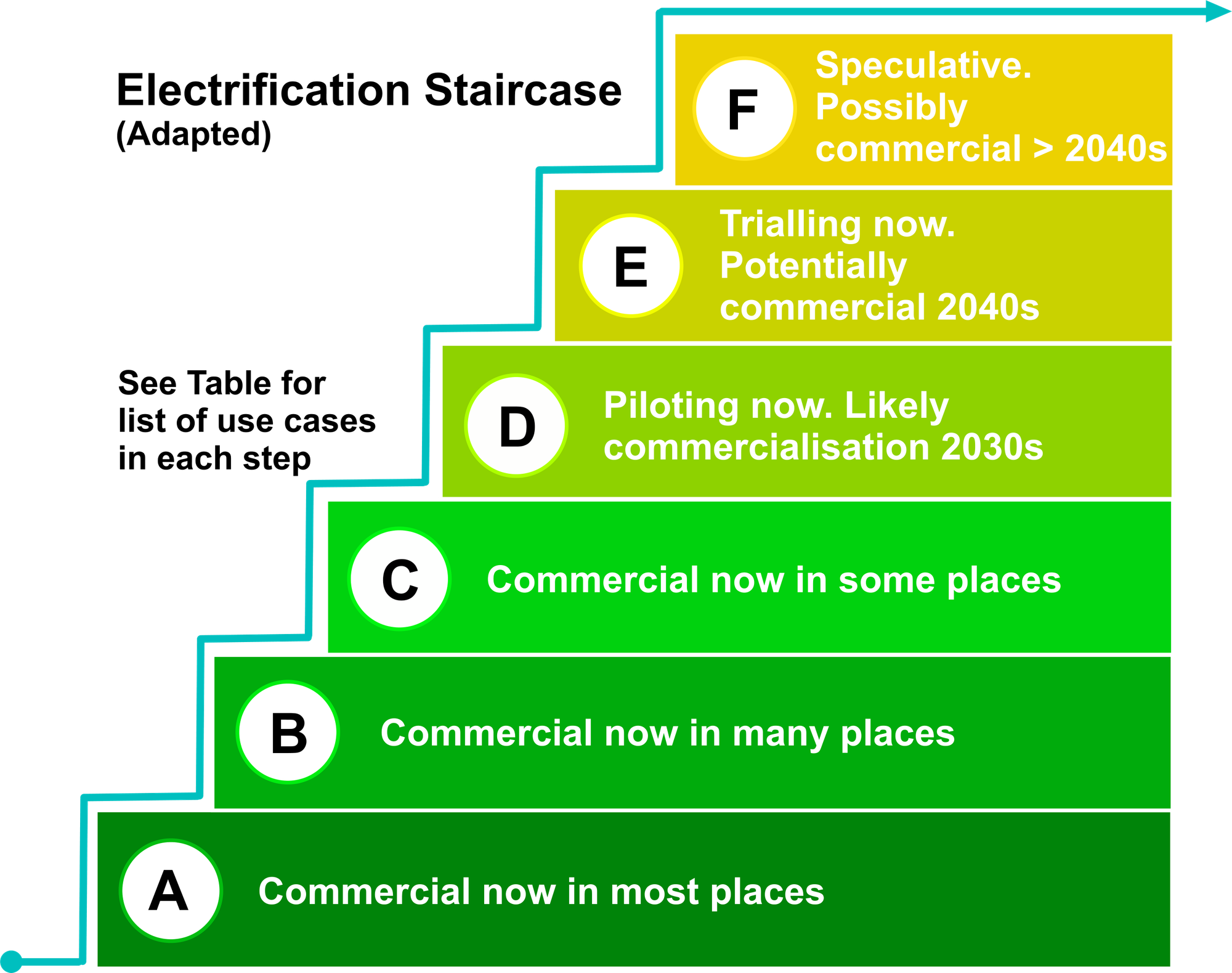
Many others have also been thinking about the issue. Now a team in Europe and the UK have developed a visualization tool to help categorize the challenge.1 Led by Michael Liebreich of Liebreich Associates, the group came up with a graphic that they are calling the "Electrification Staircase."
The staircase is based on the idea that many different electrification technologies are required for different applications or use-cases throughout the economy. They placed forty-two different use cases onto six different levels, depending on how commercial-ready they consider them to be. “Commercial” appears to combine technological fitness for purpose with financial viability. The staircase also adds a rough time-scale for when electrification of uses-cases might become viable, from right now to beyond 2040.
Table of Electrification Staircase Step Use Cases
| Step | Use Cases |
|---|---|
| A | Passenger Cars, Two-and three-wheelers, Mainline trains, Metros, Urban buses, Last-mile delivery, Heating new single-family homes, Heating new multi-family homes, Heating commercial buildings |
| B | Urban & regional trucking, Branch-line trains, Vans and light trucks, Domestic cooking, Low temp. water/steam, Retrofit heating ‘single and multi-family homes’, Industrial food dryers, Textile manufacture, Brewing & spirits, Secondary steel (EAF) |
| C | Coaches, Long-haul trucking, Ferries, Mining equipment, Paint lines, Non-road mobile machinery, Paper-drying machines, Industrial food ovens, Metals rolling & casting, Bauxite digestion/evap, Glass melting, Ceramic kiln |
| D | River shipping, Short-haul aviation, Steam crackers, Chemical process heaters, Calcination for cement/lime, Alumina calcination |
| E | Coastal shipping, Cement clinker production, Primary steel production, Hydrogen electrolysis |
| F | Medium-haul shipping, Blue-water shipping |
Adapted from E"lectrification Staircase" by Electrification Alliance
Is the Electrification Staircase the last word on deciding which technologies are viable in the near term and in every place in the world? Of course not. The staircase is a first-iteration simplification. Technology innovations and shifting costs can change feasibility and financials, so the staircase will change.
How useful is such a tool?
At the least it should prompt all of us to think more about the nuances of mass electrification. It should also help to rebut those who use examples where electrification doesn’t work yet (like long-haul commercial aviation) to argue that mass electrification is not feasible. Finally, it should be a useful guide to policy-makers as they decide where best to focus their efforts.
Reading
- Michael Liebreich, “The Electrification Staircase Is Go!,” Substack newsletter, Thoughts of Chairman Michael, May 9, 2026, https://mliebreich.substack.com/p/the-electrification-staircase-is.