Get marooned in ice. Repeatedly.
These scientists WANT their boat to get captured by Arctic ice for many months at a time. Again and again.

The Franklin Expedition, midway through the 19th century: two ships become icebound in Nunavut waters in the harshest Arctic conditions. Their leader, Sir John Franklin, dies. Of the original crew of 126, one hundred five survivors abandon ship to drag supply boats across the ice to reach the Back River, which originates in Canada's Northwest Territories. They don't make it: instead, their remains are scattered across 35 sites along the route.1
The final written note from the expedition reads in part:2
H.M. Ships Terror and Erebus were deserted on the 22nd April, 5 leagues N.N.W. of this having been beset since 12th Sept. 1846. The officers and crews consisting of 105 souls under the command of Captain F. R. M. Crozier landed here—in Lat. 69° 37′ 42″ Long. 98° 41′. Sir John Franklin died on the 11th of June 1847 and the total loss by deaths in the Expedition has been to this date 9 officers and 15 men.
Since then, we've become a lot better at dealing with ice floes.
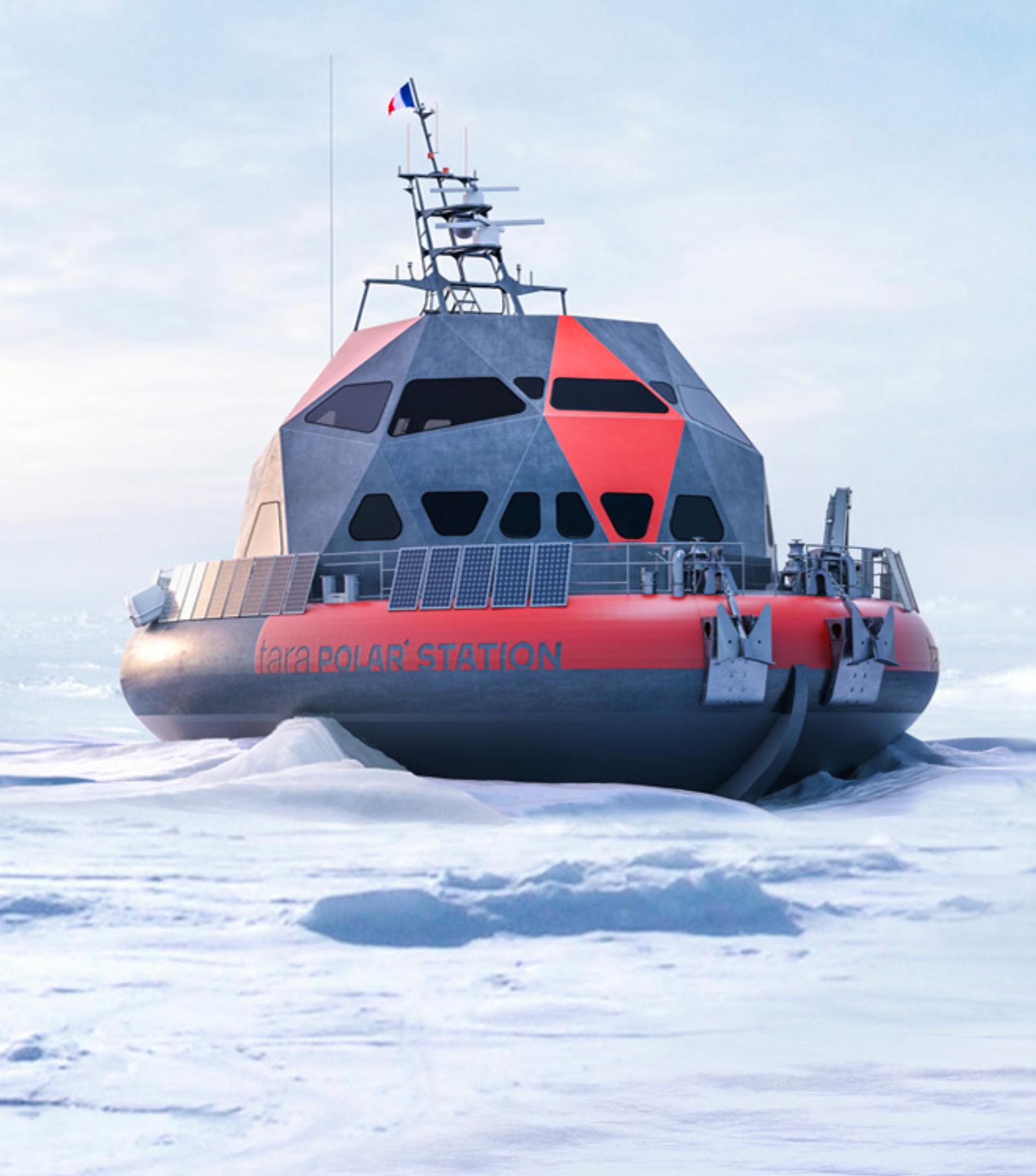
The Tara Polar Station, a novel ship launched from France last month, is gradually making its way north towards the Arctic Circle. The crew have a daunting and explicit goal: they want to be captured by Arctic ice and "go with the floe" for ... months.
They will be ice-bound for at least 9 months, beginning in September, 2026. And then they will do it again ... and again ... and, well, you get the drift. Tara plans ten 18-month missions over twenty years, with roughly 90% of the time spent captured by ice.3 It will make its way north into the ice floes with the assistance of a Chinese icebreaker. At some point, the icebreaker will turn back and the Tara Polar Station will become captured by the ice, drifting with the floe for months until the summer thaw. It will carry 10 tonnes of food for the dozen over-wintering crew.
Although the crew are adventurous, adventure is only a byproduct of the normal activities of the Tara Polar Station. It is, of course, a science ship; most of the crew are scientists. The expeditions will study the Arctic region while it transitions to an unknown new state as the climate changes. In particular, we don't know how the "new" Arctic will interact with the world's climate and how Arctic conditions might accelerate or inhibit climate change.
Our understanding of the Arctic regions is actually quite poor because they are so difficult to study. The Tara Polar Station is meant to attack that problem directly.
The design of the ship is radical and exciting. Its thick aluminum hull is oval-shaped, with a profile that, when it is trapped in ice, will be squeezed upwards, but not bent or broken. It will contain five laboratories, offices, staterooms, a heat recovery system, and its own water-reprocessing and desalination plant. It will not release effluent into the Arctic seas. Its eco-friendly engines will run on hydrogenated vegetable oil. (No word on whether or not polar bears might be attracted to a boat that has exhaust redolent of pomme frites.) It will be the most-advanced semi-permanent Arctic research platform ever built, with 220 research protocols contributed to by 30 institutions from 12 countries.
The researchers aboard will monitor the Arctic biosphere in water, air, and ice, and study how it reacts to the warming air and water temperatures. They will examine pollutants and how they change over time. The many missions will take the same measurements again and again to establish a baseline and quantify changes. But the researchers will also run many dozens of singular experiments in ocean physics, ecology, food webs, atmospheric science, climatology, and more.5
What if things go wrong? The boat will be online with a high-speed satellite uplink. It also has a jet-fuel storage tank — not for its own use, but to allow it to refuel any visiting rescue helicopters that may need to lend assistance. The crew have no plans to walk to the Northwest Territories.
You can follow the location of the Tara Polar Station using the vessel finder at this link.
Reading
- Stenton, Douglas R. “Finding the Dead: Bodies, Bones and Burials from the 1845 Franklin Northwest Passage Expedition.” Polar Record 54, no. 3 (2018): 197–212. https://doi.org/10.1017/S0032247418000359.
- Canadian Museum of History, “A Very Special Piece of Paper,” Canadian Museum of History Blog, August 16, 2018, https://www.historymuseum.ca/blog/a-very-special-piece-of-paper/.
- “Media Space.” Fondation Tara Océan, n.d. Accessed August 16, 2026. https://fondationtaraocean.org/en/media/.
- Ardyna, Mathieu, Marcel Nicolaus, Marie-Noëlle Houssais, Jean-Christophe Raut, Hélène Angot, Kelsey Bisson, Kristina A. Brown, J. Michel Flores, Pierre E. Galand, Jean-François Ghiglione, et al. “Tara Polaris Expeditions: Sustained Decadal Observations of the Coupled Arctic System in Rapid Transition.” Elementa: Science of the Anthropocene 14, no. 1 (2026): 00046. https://doi.org/10.1525/elementa.2025.00046.
- Schmale, Julia, J. Michel Flores, Kathy S. Law, Jean-Christophe Raut, James O’Brien, Assaf Vardi, Ilan Koren, François Ravetta, Slimane Bekki, Andrea Pazmino, Mathieu Ardyna, Maxime Geoffroy, Connie Lovejoy, Marcel Nicolaus, Marcel Babin, Chris Bowler, and Lee Karp-Boss. “Tara Polaris: Shedding Light on Microbial and Climate Feedback Processes in the Arctic Atmosphere.” Elementa: Science of the Anthropocene 13, no. 1 (2025): 00030. https://doi.org/10.1525/elementa.2025.00030.