Flying: It's a Drag
We’re stuck with airliners powered by fossil fuels for now, but we can significantly cut emissions with innovations that reduce aerodynamic drag.
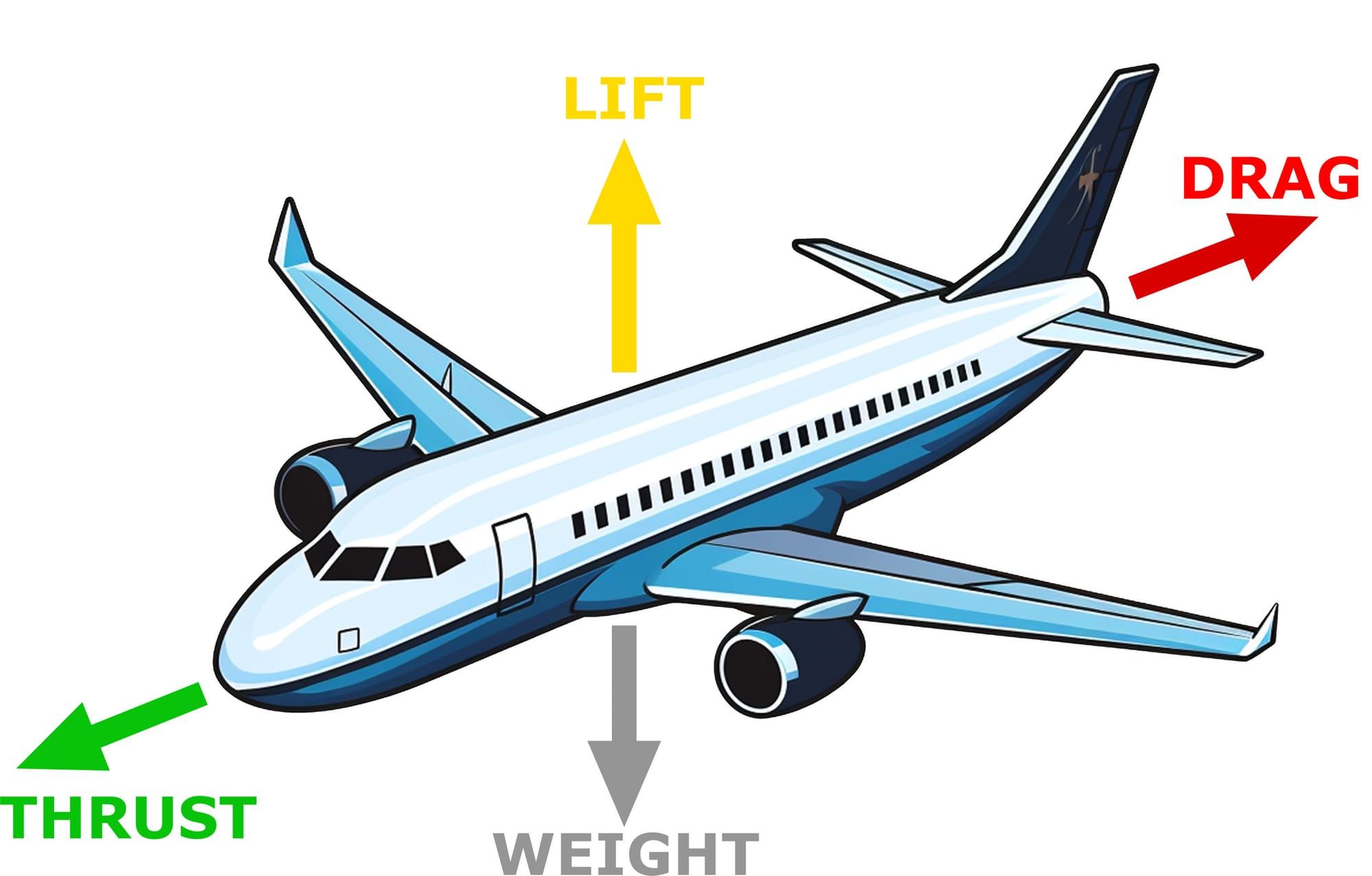
Who among us has not stuck our hand out the window of a moving vehicle and felt the wind pushing back, and noticed the big difference between holding our hand vertically and flat?
What we are experiencing is one type of aerodynamic drag, specifically “form drag.” Commercial aircraft experience that, plus several other types of drag. Overcoming those forms of drag requires thrust provided by engines, and the engines consume fuel: fossil fuel.
Commercial aviation accounts for about 2.5% of global carbon emissions.1 That might not seem like much, but it’s a somewhat intractable problem because no current renewable energy alternatives have the same energy density as fossil fuels. Energy density matters because weight control is critical for making aircraft fly. Energy-dense fuels weigh less for the same amount of work. Bio-fuels have similar energy density but haven’t yet caught on, and in the best-case scenario they only approach carbon-neutral, not zero carbon.
So, if we can’t do away with carbon-spewing aircraft fuel, we’re left with three areas where carbon reductions are possible: propulsion efficiency improvements (less energy for the same output of the engines), lighter aircraft to carry the same payload, or less drag.
There has been much work done to improve aircraft engine efficiency and to reduce aircraft weight, but recent progress has tended to be incremental.
That leaves drag. Since the work the engines do is to overcome drag, let’s review how that drag is created.
Aircraft are kept aloft by the lift generated by the wings, and that lift exactly counteracts the weight of the aircraft. An inescapable part of generating the necessary lift from the wings is drag created by air moving from the high-pressure underside of the wing, around the wing tip to the upper low-pressure side, creating a drag-producing vortex. This is called induced drag.
Other forms of drag that don’t do any useful work are known as parasitic drag, and consist of three types:
Form drag has to do with the size and configuration of the cross-sectional shape of the aircraft. This is the kind of drag your hand feels out the car window.
Interference drag is caused where air streams moving at different speeds, over the wings and the fuselage, say, meet at the base of the wings. This causes turbulence, which creates drag.
Skin Friction drag (also called viscous drag) is created by the air moving over all the surfaces of the aircraft, especially the wings. Generally, the smoother those surfaces, the less drag.
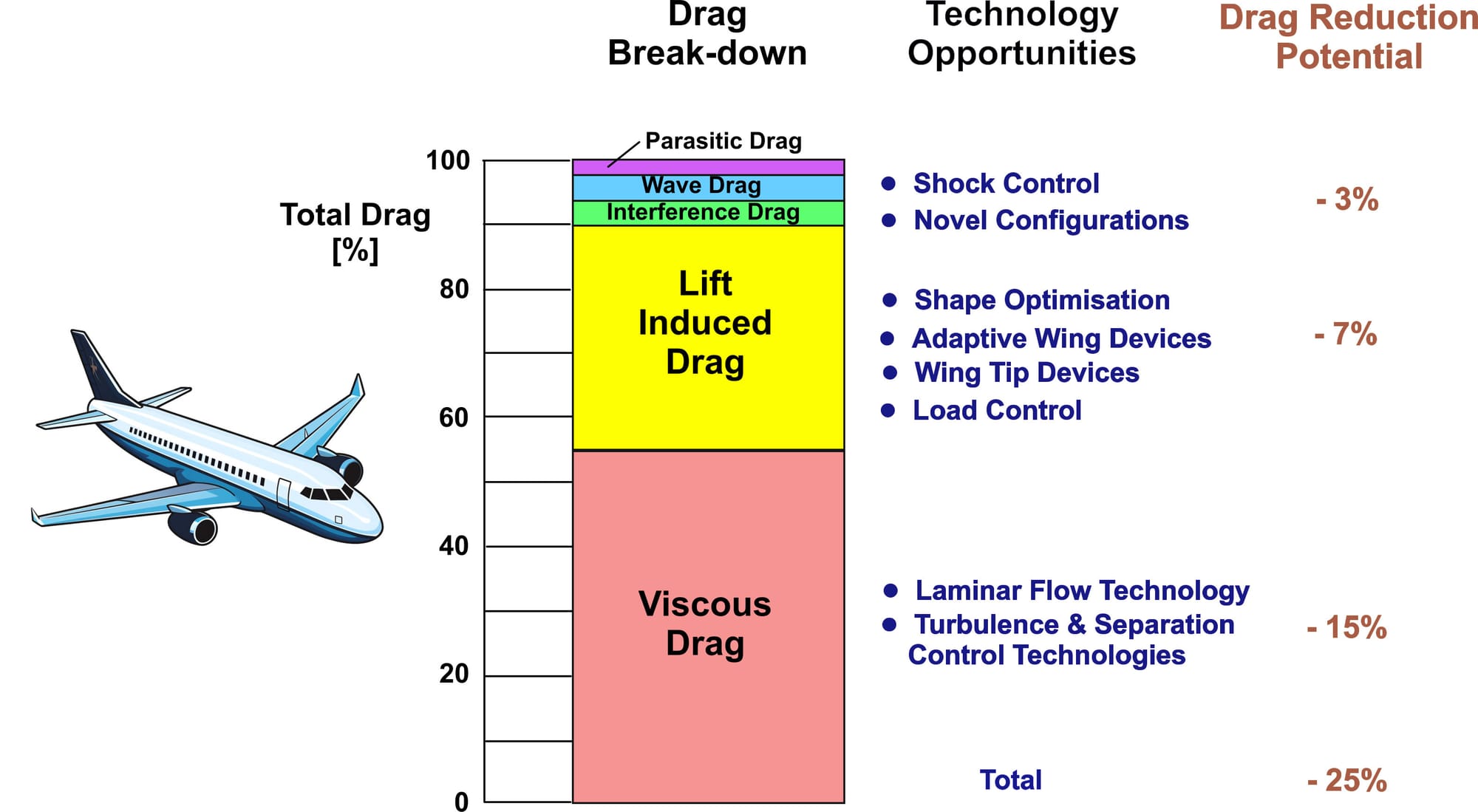
Each of four types of drag contributes a different amount to fuel consumption. Here are the approximate numbers for a typical modern long-haul commercial aircraft, like an Airbus A350, when flying at cruise altitude:2,3
- Induced drag: about 8–12% of total drag.
- Form drag: about 25–35%.
- Interference drag: about 3–8%.
- Skin friction drag: about 40–55%.
How can drag be reduced?
A plane capable of carrying several hundred passengers, baggage, and fuel has to be a minimum size, meaning any reduction from form drag has significant limits, even though it is the second largest component of drag.
Interference drag is nearly at a minimum now through the use of carefully-radiused corners between transitions.
The remaining areas of opportunity for reduction are induced drag and skin friction drag, which account for half to two-thirds of all drag.
Two common techniques for reducing induced drag are already in use. First is to increase the aspect ratio (make the wing longer and narrower) so that the size of the wingtip, and therefore the wing tip vortex, is reduced. All commercial jet aircraft have this to some extent. Second is to add an upswept winglet at the tip of the wing, to interfere with vortex formation. This technique is not universal, but is relatively common. Other innovative wing tip treatments, such as unpowered propellers, have been proposed but not implemented. Wingtip treatments can reduce overall drag by about 2%.4
Skin friction drag may be the most complex and difficult to reduce.
A simplified way of looking at skin friction drag is the air immediately next to the surface of a wing of an aircraft in flight must, by definition, be stationary relative to the wing surface. The boundary layer air stream is initially smooth (called laminar flow) and it must then transition from that surface to the speed of the surrounding air stream moving over the wing. The smoother that transition happens, the less energy is lost and the more lift is generated. At some point as the air moves across a wing, the laminar flow separates from the surface and the flow becomes turbulent, significantly increasing drag.
The big challenge for wing designers is to maintain that laminar flow for as long as possible.
In the past, most attention focused on making the surface as smooth as possible, and keeping it that way in flight. It’s why planes have to be de-iced when the weather turns wet and freezing and incorporate de-icing systems when in flight.
More recently, research and application into maintaining laminar flow involve passive efforts like different wing shapes and different wing-skin treatments. Active efforts involve changing the wing shape slightly during flight and using different control devices to modify the skin.
Passive
Changing the shape of the wings by sweeping them backwards from the fuselage lengthens the path of the air flowing over the wing, in effect slowing it down and delaying the onset of turbulence. Changing the cross-sectional area can also produce similar results. Allowing the wing to flex during flight also changes the path of the air over the wing.
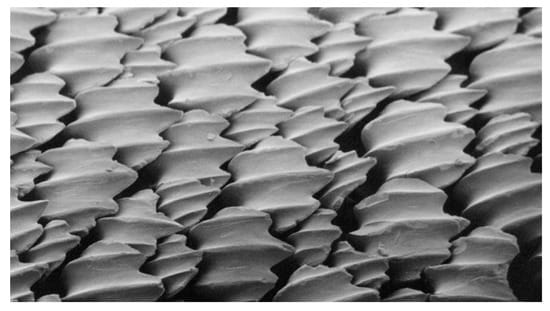
Counter-intuitively, introducing specific types of roughness to various areas of wing surfaces may either delay the transition to turbulent flow or reduce the amount of drag from turbulent flow. Various problems with the practical application of these ideas have prevented most of them from being adopted, but one promising idea comes from observing sharks. Shark skin is composed of many tiny scales with vertical keels or riblets. These riblet structures delay transition to turbulent flow and reduce the drag from the turbulence when it does develop, allowing sharks to swim faster with less energy. NASA has modelled the effect of applying riblets to a common airfoil, and found improved lift of up to 23% and reduced drag of up to 15%.5
Active
One innovation that is already in service on the Airbus A350 is morphing wings. The wings contain many electronic micro-actuators that continuously adjust wing control surfaces while in flight, without the pilot’s input. This effectively changes the shape of the wings in response to the specific conditions encountered, increasing lift and reducing drag.6
A number of schemes have been proposed to draw air into holes on the surface of the wings, which delays transition of the turbulent flow and reduces drag from turbulence. While these schemes appear promising, they don’t work well in practice due to contamination from dirt and insects. In addition, such technology requires a power supply to create the suction, together with a distribution system along the wing, adding expense and complication.
One of the more-intriguing and novel possibilities for active drag reduction is also inspired by animals: this time dolphins. It turns out their pulsed ultrasonic clicks induce drag-reducing vibrations on their skins, allowing increased speed with less energy.7 The finding inspired researchers to apply the concept to aircraft wings, at least in a computer model. The idea would be to attach multiple vibration-inducing units to the skin of the wing. While it is only a computer model at this stage, the results suggest a potential drag reduction of up to 94% and a dramatically improved lift-to-drag ratio.8 If it translates to a practical application in real aircraft, that is a huge reduction in the largest drag type.
Lowering aircraft CO2 emissions by reducing drag will not be accomplished by any one change, but given the number of innovative ideas being pursued, new aircraft will likely use significantly less fuel than those currently flying.
Correction: In the paragraph explaining induced drag, the second instance of "high-pressure" should have read "low-pressure". It has been corrected.
Reading
- “U.S. and International Commitments to Tackle Commercial Aviation Emissions | Article | EESI.” https://www.eesi.org/articles/view/u.s-and-international-commitments-to-tackle-commercial-aviation-emissions
- https://ntrs.nasa.gov/api/citations/19760003936/downloads/19760003936.pdf
- Ricco et al., “A Review of Turbulent Skin-Friction Drag Reduction by near-Wall Transverse Forcing.” https://www.sciencedirect.com/science/article/pii/S037604212100018X
- Jahanmiri, Aircraft Drag Reduction. 2011, https://www.researchgate.net/profile/Mohsen-Jahanmiri/publication/235339328_Aircraft_Drag_Reduction_An_Overview/links/0046352fa64bb7421e000000/Aircraft-Drag-Reduction-An-Overview.pdf
- Selvanose et al., “NACA 2412 Drag Reduction Using V-Shaped Riblets.” 2024, https://doi.org/10.3390/eng5020051
- https://www.airbus.com/en/products-services/commercial-aircraft/passenger-aircraft/a350-family
- Wang and Liu, “Dolphin-Inspired Skin Microvibrations Can Accelerate Swimming.” https://doi.org/10.1088/1748-3190/ae1397
- Wang and Liu, “A Novel Aerodynamic Drag-Reduction Mechanism Using Dolphin-Inspired Ultrasonic Microvibrations.” https://www.nature.com/articles/s41598-025-98585-w.pdf