Bees 1, Chemists 0
Bees make biodegradable plastic. Who knew?
One of the more intractable problems facing modern civilization is how to eliminate or reduce the harms from plastics that escape our control and end up loose in the environment. Much of that plastic is either polyethylene, used in the ubiquitous single-use plastic bag, or polyester, used in fabrics.
Plastics are just too damn useful to make it likely we’ll stop using them altogether, so we need to find ways of having them degrade into benign constituent parts. Chemists have been trying for years to develop formulations that will do just that, with not a lot of success.
Bees have beat them to it.
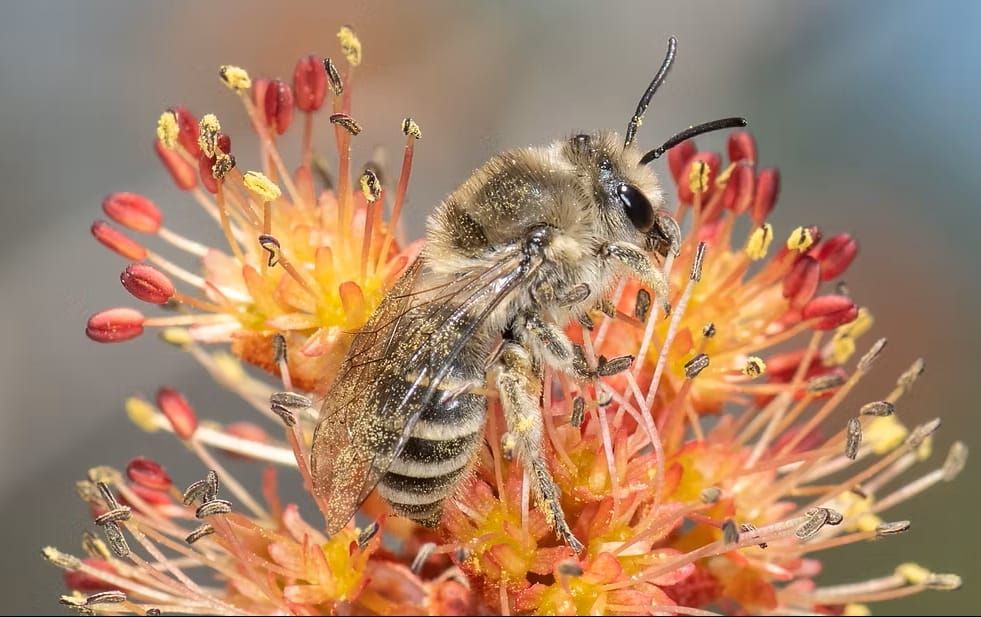
Not the more well-known honey bees or bumble bees, but cellophane bees1, genus Colletes. North America has 33 species of Colletes bees (sometimes also called polyester or plasterer bees).
Cellophane bees are small (typically less than 13 mm in length), solitary, ground-nesting bees that line their brood burrows with a kind of organic plastic that they produce. The lining protects the eggs and larvae from moisture and soil organisms as they develop into adults.
Scientists have known about this plastic-like material for at least 50 years (hence the name cellophane bees), but the material's properties had not been studied.
While the bees are solitary, they frequently choose similar ground for their nests, such that some suitable areas, to which the bees return year after year, may host thousands of nests.
That raises an intriguing question. If the lining material is a kind of plastic, why doesn’t it build up in the ground in those areas that are dense with nests? It must degrade somehow, but why?
Researchers from several US universities looked at one common, specific species of cellophane bee, Colletes inaequalis, to try to understand what exactly the cell lining is made of, and how and why it breaks down.2
By tracking some nest linings over the course of a year, they discovered the material lasts long enough to protect the bee until it is an adult, but breaks down (mostly) within a year. Analyzing the lining material, they found it to be a kind of polyethylene-polyester (PE-like polyester).
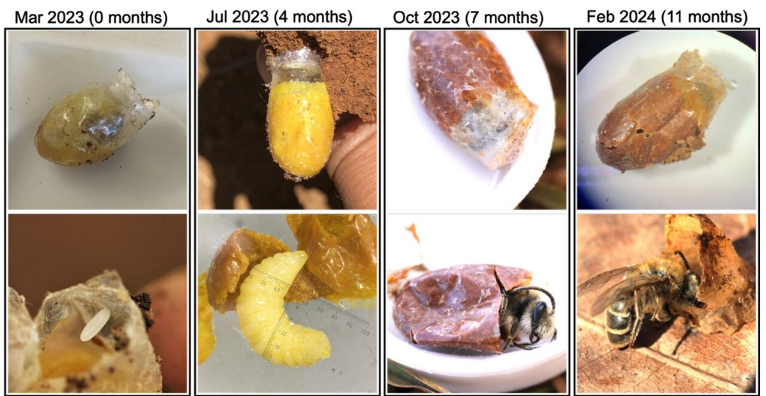
Here’s the thing. In theory, petroleum-derived PE-like polyesters should biodegrade, but in practice they don’t, while the bees’ PE-like polyester does.
The scientists are still not sure why. They theorize it might have something to do with the details of how the bee plastic cross-links (cross-linking is what makes it a plastic in the first place), and maybe also with the presence of enzymes that promote breakdown.
Bees clearly know how to make biodegradable plastic. With more work we may learn their secret of how to make plastic that lasts only as long as we need it and then quietly degrades.
We should be grateful they won’t charge us royalty fees.
Bonus fact: Colletes bees are important early-season pollinators, emerging before honey bees.1
Reading
- “Cellophane Bee - Colletes Bee,” nybee28Oct2026, accessed November 4, 2026, https://www.sharpeatmanguides.com/cellophane-bees.
- Jonathan P. Coote et al., “Rapid Soil Degradation of a Cross-Linked, Semicrystalline Polyethylene-like Polyester Produced by Colletes Bees,” Proceedings of the National Academy of Sciences 123, no. 46 (2026): e2607098123, https://doi.org/10.1073/pnas.2607098123.