Coral Reefs and Biorock
Coral reefs, one of nature's wonders, are threatened by global warming, but we may be able to help them recover.
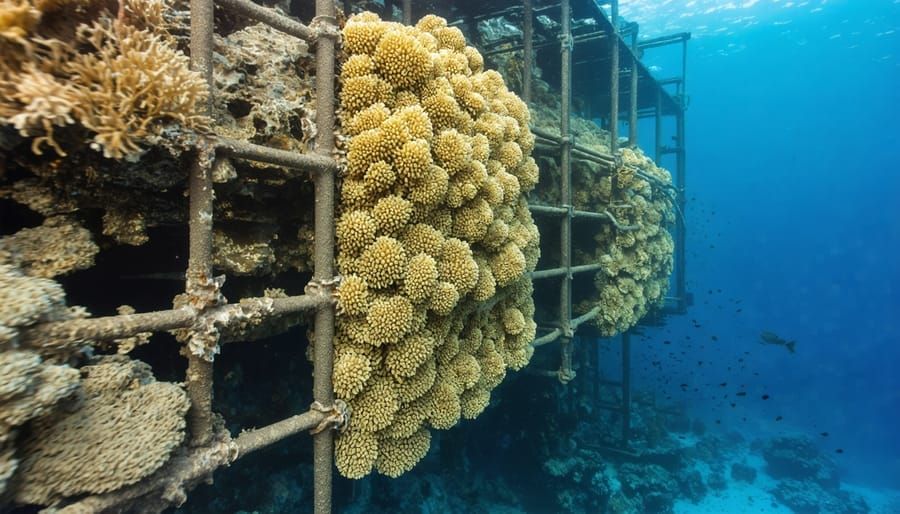
If you have ever snorkeled above or dived on a coral reef, you were no doubt captivated by the beauty and variety of the corals and the number and variety of fish found on the reef.
Corals, the animals that make up the reefs, are invertebrate animals of astonishingly complex form, habitat, and growth mechanisms (over 2,000 species).1 Individual coral animals, known as polyps, mutualistically2 host Zooxanthellae algae. Corals derive their colours from various types of those algae. Coral polyps provide shelter and carbon dioxide (CO2) for the algae, which, through photosynthesis, turn the CO2 into oxygen, sugars, proteins, fats, and carbohydrates. Corals use these products to live, grow, and reproduce. Corals also produce skeletons in a form of calcium carbonate known as aragonite, which give coral reefs their structure. Aragonite is essentially a type of limestone, familiar to us as marble used in statuary and architecture.
Coral reefs are disproportionately important to the marine environment, supporting 30% of all known species, even though they cover only 0.2% of the ocean floor. They provide habitat, feeding grounds, and serve as nurseries for young fish. Coral reefs are also critical for humans, 13% of whom live within 100 km of a coral reef. Coral reefs provide shoreline protection, food, mental health benefits, and livelihoods from tourism and fishing.3
Coral reefs worldwide are under threat from climate change-induced ocean heating, increased acidification, more storms, and more powerful storms. Of these, the greatest reduction in hard coral cover results from ocean heating. Marine heat waves cause coral polyps to expel their algae. The result is called a "bleaching event" from the white colour of the remaining algae-less coral polyps and their white skeletons. Given enough time, coral can recover, but repeated bleaching events result in coral death and loss of their supporting skeletons. Hard coral reef cover-area has declined an average of 9.5% over the past five decades, most of that due to repeated bleaching events since 2010.3
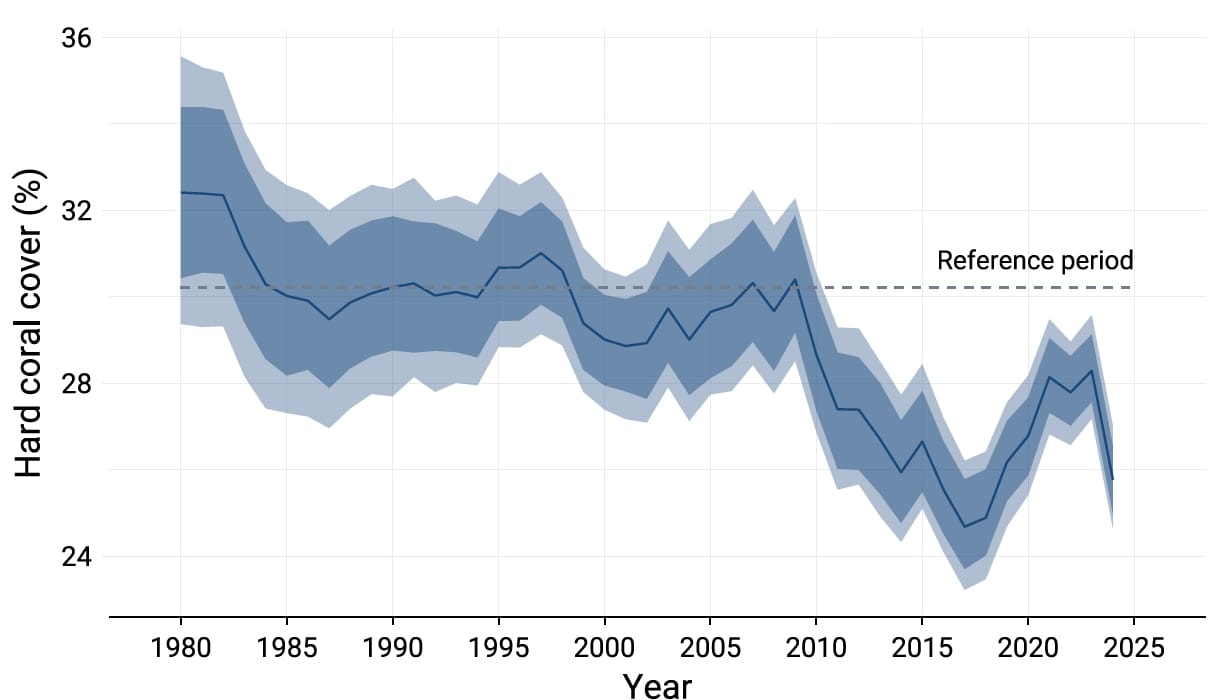
Warming events since 2010 include several El Nino occurrences: one weak, two strong, and one very strong. In 2026 and 2027, we are experiencing another El Nino, which is predicted to be very strong.4
Corals can recover somewhat in the shorter term, but recovery takes time, and time between bleaching events seems to be getting shorter.
It's a grim picture.
What, if anything, can be done?
The long term answer is to reduce global warming from climate change, but that will take time, and corals are threatened now.
What if coral recovery can be sped up or if scaffolding can be created for growth of new coral?
It CAN be ... using low voltage mineral deposition technology. The technology was first developed by the architect WH Hilbertz in the 1970s, who patented the process under the name "Biorock" (patent since expired).
Biorock is created by applying low DC voltage (1.2-2.5V) to metal structures in the sea. Calcium and carbon in the seawater precipitate in the form of calcium carbonate over the cathode part of the electrical circuit (the metal frame). Rates of accretion depend on the specific voltage, water temperature, acidity of the water, and level of suspended sediments, but can be 2-9 times faster than natural coral skeleton growth.5 The resulting rock is comparable in strength to both natural coral and to concrete.
OK, but that sounds like an artificial reef, which clearly has value, but how does it help coral reefs?
It enhances their growth, and here's one typical example. Researchers in Indonesia conducted field experiments in Bali using Biorock technology to enhance the growth of transplanted coral fragments. Different size fragments were tied to iron cages, and stimulated with varying DC voltages (0V, 6V, and 12V). After 12 weeks, the researchers found the stimulated coral fragments grew significantly faster and had higher survival rates than the un-stimulated fragments. The researchers also cite other experiments that have also reported positive results.6
A broader survey review of other Biorock projects reports hard coral growth rates under electrical stimulation to be 2-10 times that of un-stimulated controls, depending on individual circumstances.7
Why does this happen?
The review proposes that the mechanism for this enhanced growth is akin to how cellular membrane cuts heal in the presence of electrical fields, but provides no supporting evidence.
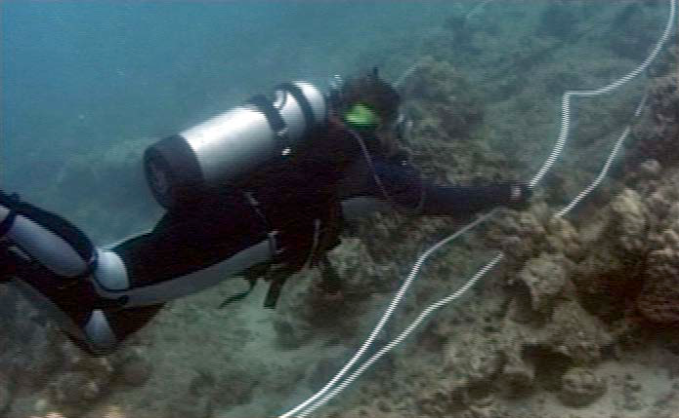
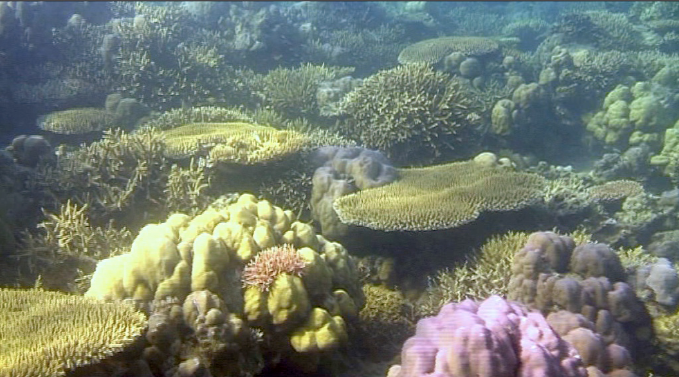
Regardless, it seems to work. The before and after images of reefs where Biorock technology has been used are visually striking.
What are the limitations or downsides of deploying this approach more widely?
- Electrical supply. The most obvious drawback is the need for a near-continuous power supply and the supporting infrastructure. Can robust systems be built cheaply enough? While we can imagine something like floating solar panels dedicated to sections of coral reef, the engineering challenges of doing this at scale would not be trivial.
- Cheaper anode material. At present, while the cathodes are iron, the anodes are titanium, which is expensive and scarce in most places that host coral reefs. Some researchers are exploring alternatives.8
- Maintenance. In areas where coral reefs are subject to periodic sedimentation due to monsoon rains, growth is reduced unless the Biorock installations are regularly cleaned.9
Notwithstanding the difficulties in applying this technology widely, it is encouraging to know that something can be done to help coral reefs survive the warming ocean, rather than just watch them disappear.
Reading:
- Coral Reef: Description, Geochemistry, Origins, & Threats: Britannica, August 14, 2026, https://www.britannica.com/animal/coral.
- National Oceanic and Atmospheric Administration US Department of Commerce, "Coastal Pollution Tutorial: NOAA?s National Ocean Service Education," accessed September 7, 2026, https://oceanservice.noaa.gov/education/tutorial_corals/coral02_zooxanthellae.html.
- "Status of Coral Reefs of the World: 2025" GCRMN, n.d., accessed September 7, 2026, https://gcrmn.net/2025-report/full-report/.
- "El Nino and La Nina Years and Intensities," accessed September 20, 2026, https://ggweather.com/enso/roni.htm.
- Lucia Margheritini et al., "Innovative Material Can Mimic Coral and Boulder Reefs Properties," Frontiers in Marine Science 8 (June 2021), https://doi.org/10.3389/fmars.2021.652986.
- Dias Natasasmita et al., "The Effects of Electrical Voltage Differences and Initial Fragment Size on Growth Performance and Survival Rate of Coral Acropora Cerealis in Biorock Method," Journal of Aquaculture & Marine Biology 4, no. 4 (2016): 62-65, https://doi.org/10.15406/jamb.2016.04.00086.
- Thomas J. Goreau, "Electrical Stimulation Greatly Increases Settlement, Growth, Survival, and Stress Resistance of Marine Organisms," Natural Resources 5, no. 10 (2014): 527-37, https://doi.org/10.4236/nr.2014.510048.
- Zazilah May et al., "Computational Sensitivity Analysis of Anode Materials for Optimizing Electrochemical Mineral Accretion in Biorock Applications in Malaysia," 2026 IEEE 16th Symposium on Computer Applications & Industrial Electronics (ISCAIE), April 2026, 1?6, https://doi.org/10.1109/ISCAIE68866.2026.11576443.
- K. Ramkumaran et al., "Record of Coral-Associated Benthic Fauna Recruitment on the Biorock Reef Structures at the Reef Restoration Sites in the Gulf of Kachchh," Records of the Zoological Survey of India, September 16, 2025, 391-98, https://doi.org/10.26515/rzsi/v125/i2S/2025/172996.