No One Said It Would Be Easy
An Australian mining company's first attempt to build an entirely gravity-powered ore train doesn't quite work (yet), but we shouldn't be discouraged.
In 1836 a mining company in Wales built a railway to carry roofing slates from the mines in the hills around Blaenau Festiniog down to the harbour at Porthmadog, a distance of about 22 kilometres (13½ miles). The trains on the line had no engine, relying on gravity, a continuous track gradient, and man-activated brakes on each slate-filled wagon to safely transport the stone down. Initially, horses were used to drag the empty wagons back up, with the horses being replaced by coal-fired steam locomotives in 1863. The gravity trains operated commercially until 1939.1
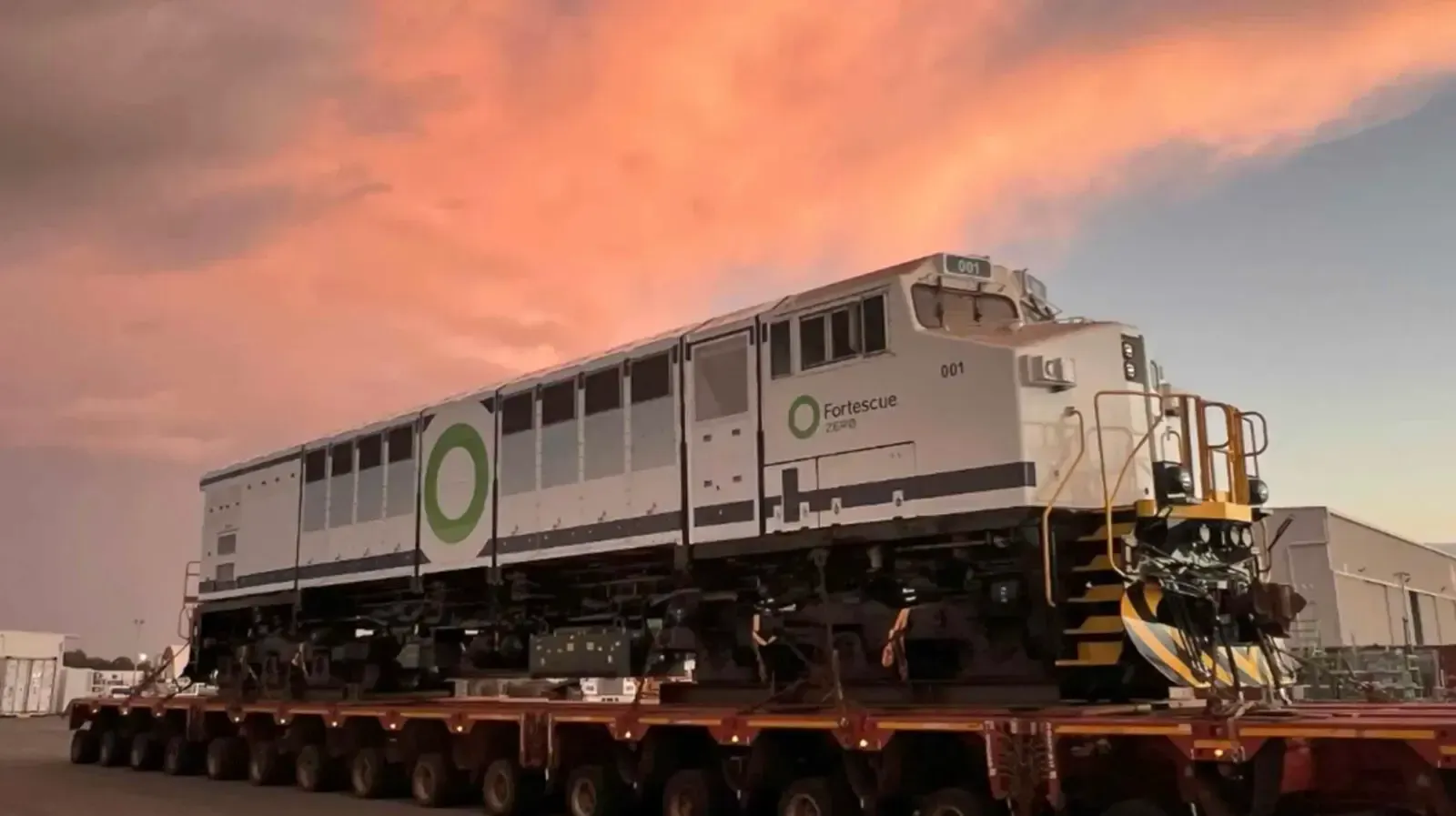
In 2022 Fortescue Metals Group Ltd, a West Australia mining company, developed a plan to build a gravity-powered ore train, with a modern twist, in the Pilbara region of northwest Australia as part of their way to meet their net-zero climate goals.
Currently, iron ore is moved by train from the mines in the hills down to Port Hedland on the coast. Each ore train is huge, 2.8 kilometres long, carrying about 34,000 tonnes. The furthest mine at Eliwana is 428 km by rail from the coast and is at 500 metres elevation. On the downhill run, brakes need to be applied much of the way. Diesel-electric locomotives haul the empty ore cars back up.
Locomotive diesel fuel currently makes up about 10% of Fortescue’s carbon emissions.
Fortescue embarked on a project, called the Infinity Train, to replace the diesel-electric with battery-electric locomotives. Instead of using friction brakes to slow the train, the electric motors on the battery-electric locomotives would act as generators to slow the train and store the braking energy in the batteries. That stored energy would be used to haul the empty trains back up the hill, with no external energy source required. Fortescue planned to eliminate all the diesel fuel powering the diesel-electric locomotives.
Hang on, you say to yourself, that sounds suspiciously like a perpetual motion machine and you know the second law of thermodynamics says that is impossible.
You're right, but there is no perpetual motion at work in this instance.
Geological processes over long, slow eons did the work of locating the iron ore deposits at a high enough elevation to exploit for moving the ore to the coast. What the train would actually do is convert the gravitational potential energy of each 34,000-tonne load of ore, located at 500 m elevation, into kinetic energy first, then into electrical energy, and store it in the batteries to be used on the return uphill journey with empty ore cars.
The gravity train is a brilliant concept, but implementing it needs to make engineering and economic sense. After 3 years of effort, the team working on the project has concluded that the current state of engineering, together with unexpected economic challenges, make it too expensive to proceed, at least for now.
What are the problems?
The first problem: more battery-electric locomotives than existing diesel locomotives would be needed (up to 9 from existing 2-4) in order to store enough energy. This would add too much cost. More ore cars could be added (more potential energy) but the resulting trains would not fit existing sidings, so those sidings would have to be extended, adding more cost. Longer trains would also increase the risk of ore car couplers failing, leading to derailments and lost production.
The company also looked at providing part of the electrical energy from off-track solar and using overhead wires on a section of track to add charge to the batteries. The costs for this solution would be high, and some parts of the construction would require shutting down the lines, meaning lost production and lost revenue.2
It seems that while the basic concept is sound from a physics perspective, the technical details of implementation make it too costly to build on the one hand, and some aspects of the solution would reduce revenue, on the other – a double whammy that has killed the immediate implementation. Fortescue has paused development of the idea, and laid off much of the staff working on the project, although they say they have not abandoned the idea altogether.3
It would be easy to dismiss this story as yet another failed attempt to replace fossil fuels with renewables, a cautionary tale that proves renewables are not up to the job, but the story highlights a deeper truth.
We (and others) have argued before that the world's industrial systems need to be electrified as much as possible to reduce emissions, in order to meet climate goals. We shouldn’t be discouraged by initial failures like this.
Most of the modern technologies we take for granted weren’t adopted in a single step. Often they required many incremental advances, with not a few blind alleys and reverses along the way.
There is no reason to expect the technologies needed for the energy transition won’t be the same.
As Jared Diamond put it, ''We tend to seek easy, single-factor explanations of success. For most important things, though, success actually requires avoiding many separate possible causes of failure."4
Fortescue’s Infinity Train project doesn’t make technical and economic sense now, and may never, but we can imagine future advances in key technologies like battery power density that might make it feasible.
On our journey to become a resource-conservation-focused society, we will need many audacious attempts like this, some successful, some not, to get there.
Reading
- Wikipedia. “Ffestiniog Railway.” October 8, 2025. https://en.wikipedia.org/w/index.php?title=Ffestiniog_Railway&oldid=1315753972.
- https://www.boilingcold.com.au/fortescue-slashes-electric-train-program-but-insists-zero-emissions-on-track/ accessed 11 Nov 2025
- https://www.fortescue.com/en/articles/fortescuewilliamswaesettlementpowersdevelopmentofworldfirstinfinitytrain20220301, accessed 11 Nov 2025
- ''Guns, Germs, and Steel, The Fates of Human Societies", W.W. Norton & Company, New York, 1999, p. 157