Fusion
Often thought of as the "other" nuclear energy source.

Fusion is having a moment. Investments in it have been on the rise recently, accompanied by announcements and a few notable breakthroughs. Things like data centres drive the need for a long-term low-carbon power source to meet climate and new energy demands. Governments have been funding fusion research, notably the ITER (International Thermonuclear Experimental Reactor), estimated at €21-26 billion Euros to date. Headquartered in France, it unites thirty-five member nations to look at scientific and technological feasibility for peaceful uses of fusion. Private venture and corporate sources have invested €6-7 billion Euros to date in a rapid increase that began around 2018.1,2
Fusion is often thought of as the "other" nuclear energy source. Fusion and fission are sometimes mistaken for each other, even though they are fundamentally different. In simple terms, fission describes a process of breaking apart heavy atomic nuclei, while fusion is a process of combining light atomic nuclei. Both of these nuclear processes release energy when they happen. To convert this to useful electricity, today both fusion and fission need some sort of heat engine: something like a steam turbine. On a per-reaction basis, fission releases more energy than fusion, although on a per-mass basis, fusion is more energy-dense since the particles are much smaller.3
First some terminology. In order to achieve fusion, a plasma of atomic isotopes of hydrogen must be created. Think of plasma as a very hot "soup" of particles that are brought to conditions of temperature, density, and confinement time needed to create a fusion reaction. Fusion researchers measure success using the “Q factor,” the ratio of energy produced to energy required to sustain the reaction. When Q is greater than one, a reaction can continue without external input, and can be used to produce energy. The Q factor can be measured at the plasma level (useful for scientific comparison) but can also be measured at the engineering level, taking into account all the energy needed to make a reaction occur, things like magnetic fields and heating. Lastly, scientists talk about "ignition", which refers to a state where the fusion reaction is largely sustained by its own internal heating.4
Fusion and fission differ in many ways, primarily:
- Reaction control: In a fission reactor, energy is produced through a chain reaction; each reaction triggers another and must be carefully controlled to prevent overheating. In a fusion reactor, the reaction is sustained by maintaining plasma conditions, including heating from alpha particles. Fusion is not a chain reaction and therefore does not carry the same runaway risk.
- Radioactivity and waste from a fusion reactor is much smaller than from a fission reactor (Nuclear Energy 2: Hot Bananas and Radiation Risks), although it still produces radioactivity. Tritium is used as a fuel and must be bred within the reactor. High-energy neutrons produced in fusion reactions can be absorbed by surrounding materials, making them radioactive—a process known as activation. Waste requires containment for decades rather than for millennia.5
- Energy production occurs today in operating fission reactors around the world, but fusion reactors have yet to be built and produce no commercial power.
Okay, let's go back to school for a moment and have a look at fusion.
At the nuclear level, it looks like this:
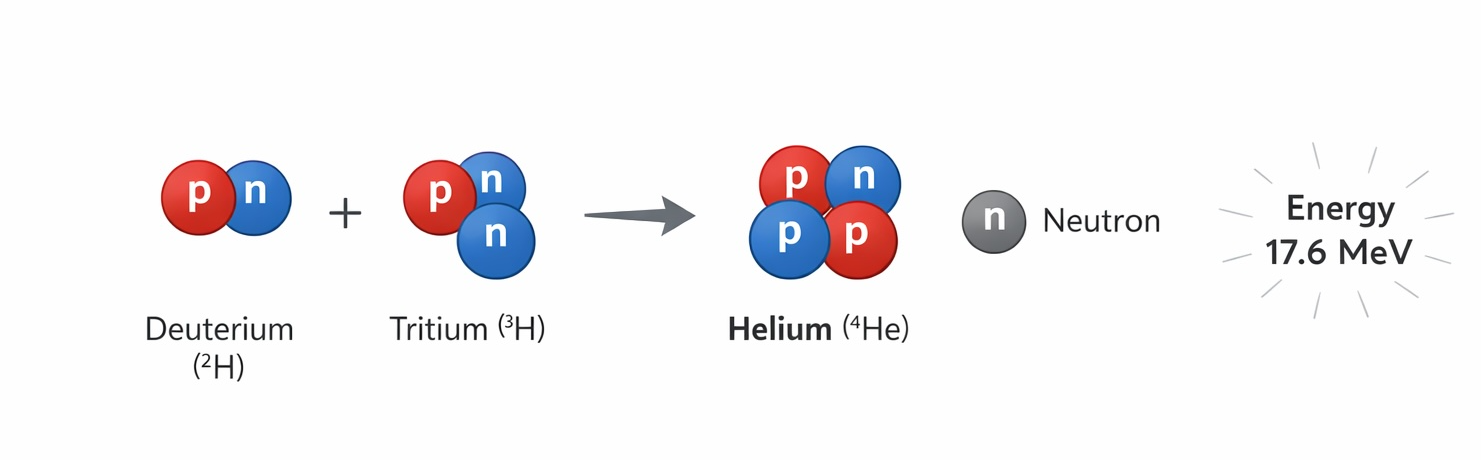
Basically the fusion reaction involves isotopes of Hydrogen (Deuterium and Tritium) combining to produce Helium, a free neutron, and some energy.
In 1957, British physicist John Lawson posed a simple question: “What conditions are required for a fusion reactor to produce more energy than it consumes?” The answer to this question is called the Lawson criterion. John Lawson did not produce a formula for achieving fusion, but rather a set of conditions that must be met for it to occur: the product of temperature, density, and confinement time must exceed a threshold for fusion to produce net energy. This transformed fusion from a theoretical possibility into a measurable engineering challenge. 6
It turns out to be a big challenge!
Today, scientists are using two different approaches to experiment with fusion. In the first, several lasers strike a core fuel pellet, causing its outer layer to explode outward. This compresses the internally enclosed fuel, causing the density and temperature to rise dramatically, resulting in a fusion reaction. This reaction only lasts for nanoseconds. The other approach is called a Tokamak reaction, in which fusion is contained using powerful magnetic fields. These fusion reactions can be sustained for seconds, with designs on the books where reactions will last longer. The target for these types of reactions is to enable continuous operation, with plasma at steady state, as would be needed in a commercial power plant.
Research and investments in fusion have been going on for several decades. During most of this time fusion has carried the reputation of being perpetually “ten years away.” The phrase persists not because progress has stalled, but because each advance reveals new layers of complexity. In the last decade, scientists have achieved several important milestones on the path to viable fusion. Still, if asked how far away a viable fusion reactor might be, the estimate is still "ten years."
Recent developments
In 2022 at Lawrence Livermore - National Ignition Facility, a laser-driven fusion experiment achieved ignition with Q (plasma level) of approximately 1.5 (3.15 megajoules output vs. 2.05 megajoules input). The reaction lasted for nanoseconds, so a scientific breakthrough ... but not a continuous self-sustaining reaction.7,8
In 2025, the Chinese announced that they sustained high temperature plasma for eighteen minutes in their E A S T (Experimental Advanced Superconducting Tokamak) reactor. In what the Chinese called their "artificial sun" reaction, they achieved a record breaking result for containment of high temperature plasma, although it did not deliver net energy (Q>1). 9
Some companies are pursuing alternative fusion approaches that fall between traditional magnetic and laser systems. One example is General Fusion’s magnetized target design, which compresses a magnetized plasma using a surrounding layer of liquid metal. The liquid serves multiple roles—absorbing energy, breeding fuel, and protecting the reactor structure. While conceptually attractive, these approaches remain experimental and have yet to demonstrate net energy production.10
Fusion reactor - the Sun
Fusion energy is already the most pervasive and clean source of energy on Earth. We use it every day and we wouldn’t exist without it. The Sun is, in essence, a giant fusion reactor that heats and lights our planet and provides the means for life to exist. It operates continuously and provides by far the most energy on Earth, even though the reactor is located 93 million miles away.
In the Sun's core, where most of the fusion reactions occur, the temperature is about fifteen million degrees C. This high temperature combines with immense gravity, about twenty-eight times stronger at the Sun's surface than at Earth’s, to compress the Sun's core to extraordinary pressures. This allows fusion to occur at temperatures far lower than those required in terrestrial experiments, which need to achieve around 100 million degrees C or higher.11
The Sun's immense gravity also contains the reaction. The energy given off is initially in the form of Gamma rays, which are very high-energy photons. Photons from the plasma in the Sun's interior can take 10,000 to 100,000 years to escape and, eventually, be transmitted. During this time, the energy of the photons is gradually redistributed and reduced from Gamma rays to X-rays, ultraviolet, and finally to visible light.12
The scale is difficult to grasp. The Sun produces roughly 3.8 × 10²⁶ watts of power. Only a tiny fraction of that energy reaches Earth—about one part in two billion. And yet, even that small fraction is enormous. It is more than enough to drive the planet’s climate, power the water cycle, and sustain all known life. Every forest, every river, every gust of wind is, in some sense, a downstream effect of solar energy. Even fossil fuels—coal, oil, and natural gas—are simply stored solar energy, captured by ancient biological systems and compressed over millions of years.13,14
We often speak of “producing” energy, but this is a convenient simplification. We do not produce energy—we extract it. For most of human history, that has meant unlocking energy stored over long periods of time: burning wood, then coal, then oil and gas. Each step has drawn on increasingly concentrated reserves, but also left lasting environmental consequences.
Fusion energy from the sun — solar energy — is different. It is not a finite stock but a continuous flow that arrives whether we use it or not. The Sun provides more than enough clean energy to meet humanity’s needs. It is also one of the only energy sources that can be converted directly into electricity, without the use of a thermal power plant.
The challenge of fusion on Earth is not proving that it works: we see it working every day. We don’t need to invent fusion, we just need to find better ways to harvest it.
Shouldn't be too difficult; after all, we have a lot of experience extracting energy from nature.
Maybe this time we can do it without damaging our environment.
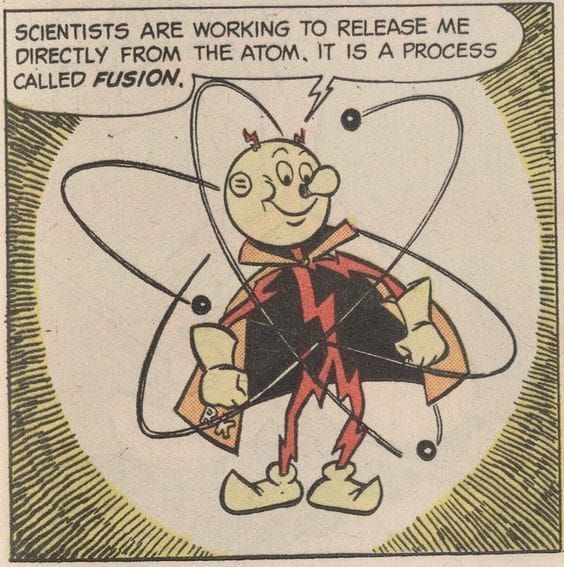
Promotional art featuring Reddy Kilowatt from the utility‑industry educational program The Mighty Atom, starring Reddy Kilowatt (circa 1959), produced for investor‑owned electric companies to explain nuclear power; exact originating comic/filmstrip panel and utility sponsor unknown. Image via contemporary reproductions (e.g., The Vault of the Atomic Space Age).
Sources and influences for this article include reports from the IAEA, ITER, and the U.S. Department of Energy, as well as the CBC Ideas podcast episode “A Machine That Could Save Us from War — and Global Warming” (April 10, 2026).
Reading
- ITER Organization. “ITER Project Overview.” https://www.iter.org.
- Fusion Industry Association. Global Fusion Industry Report, 2024.
- World Nuclear Association. “Tritium.” https://world-nuclear.org
- MIT Plasma Science and Fusion Center. “Introduction to Fusion Energy.” https://www.psfc.mit.edu/.
- International Atomic Energy Agency. Fusion Physics. Vienna: IAEA, 2012.
- Lawson, J. D. “Some Criteria for a Power Producing Thermonuclear Reactor.” Proceedings of the Physical Society B 70, no. 1 (1957): 6–10.
- Lawrence Livermore National Laboratory. “LLNL Achieves Fusion Ignition.” December 13, 2022. https://www.llnl.gov.
- U.S. Department of Energy. “DOE National Laboratory Makes History Achieving Fusion Ignition.” 2022.
- Chinese Academy of Sciences. “EAST Tokamak Sustains Plasma for Over 1,000 Seconds.” 2025.
- General Fusion. “Magnetized Target Fusion.” Accessed April 2026. https://generalfusion.com.
- NASA. “The Sun: Structure and Composition.” https://science.nasa.gov.
- National Solar Observatory. “How Energy Moves Through the Sun.” https://nso.edu.
- NASA. “Solar Energy Output.” https://science.nasa.gov.
- National Renewable Energy Laboratory. “Solar Radiation Basics.” https://www.nrel.gov.