Here There Be Whales
What? Humpback whales are back from the brink?

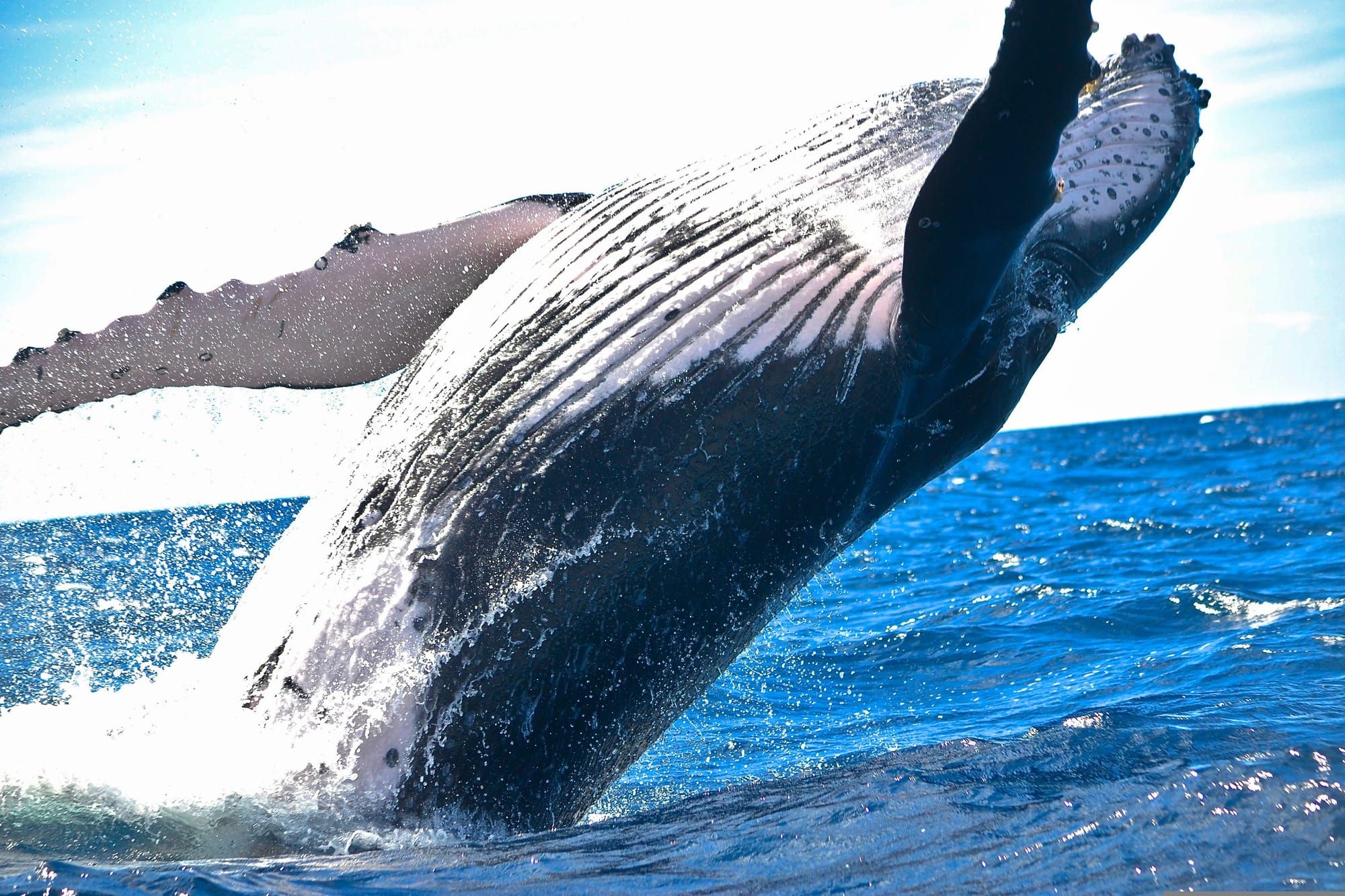
Yes! After being listed as "endangered," humpback whales have made a dramatic recovery.
Different geographic populations of humpbacks have been exploited, declined, and recovered on different schedules. These days, most populations are increasing.
For example, a well-studied group of humpback whales in the Western South Atlantic (WSA) mate and calve on an oceanic shelf off the coast of Brazil in winter and spring. From November to March, they migrate 4,000 to 5,000 kilometres south to the waters near Antarctica, where they feed on krill and small schooling fish.2
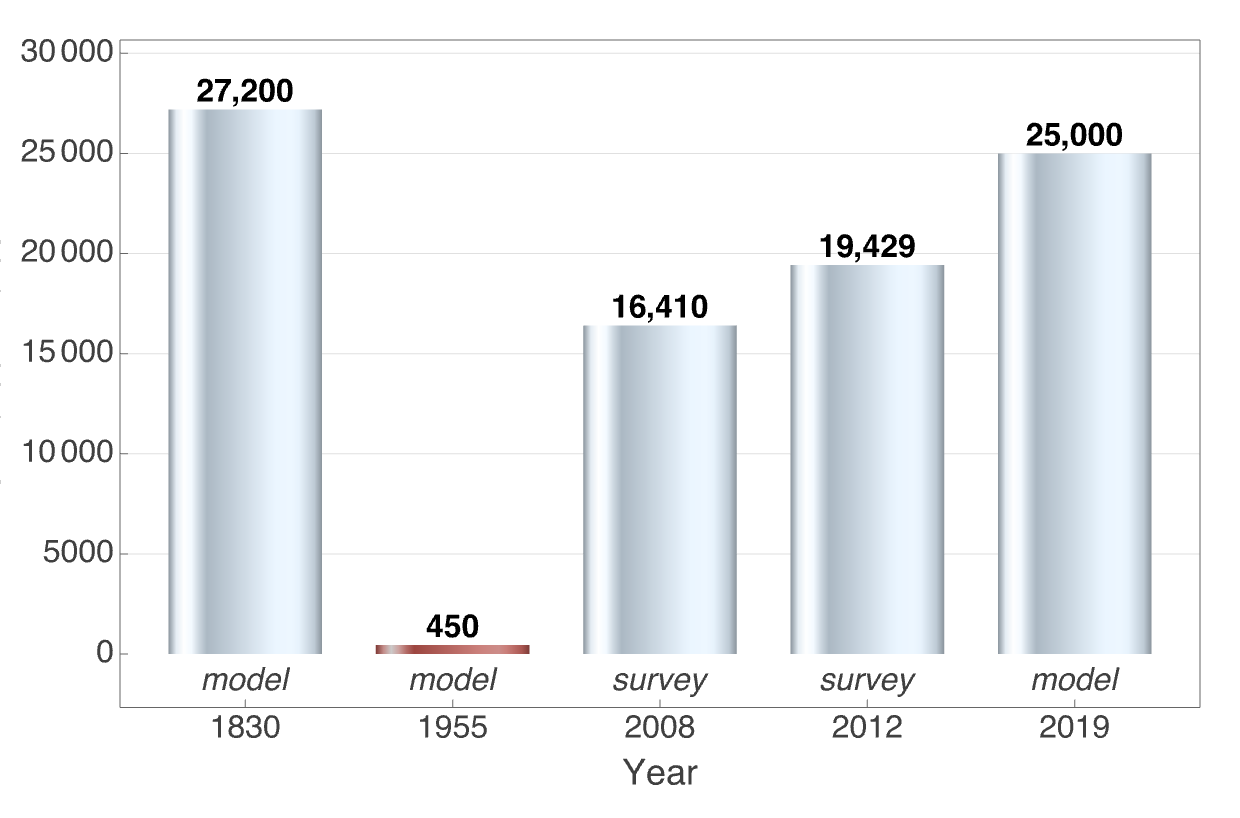
Cetacean researchers treat 1830 as "effectively pre-exploitation" in that region, before industrial whaling methods moved to the Antarctic and sub-Antarctic regions.
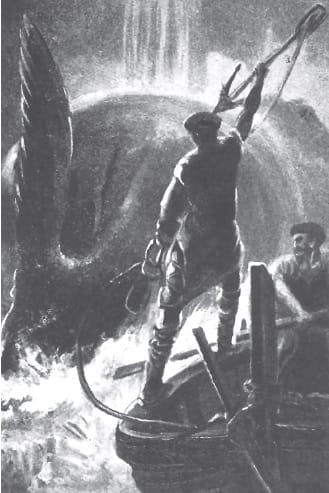

The transition from basque-style sail-and-rowboat whaling to harpoon cannons and steam-powered catcher boats led to a period of heavier exploitation that culminated in factory ships and explosive-tipped harpoons in the 20th century.
No reliable survey data exists for the pre-exploitation WSA humpbacks, but clever population models integrate catch data, abundance estimates, and genetic and biological studies to give a high-confidence count of 22,800 to 33,000 whales around 1830.
These same models estimate that, by 1955, the WSA humpbacks had been reduced to near extinction: somewhere between 200 and 1400 whales, with a best estimate of 450 individuals.3 Historical records show roughly 25,000 WSA humpbacks were killed in the region around South Georgia (located in the sub-Antarctic region south of 54 degrees) from 1904 to 1916.4
Recent research cruises, conducted by marine-mammal research teams aboard the research vessel Atlântico Sul of the Universidade Federal do Rio Grande as part of the Monitoring Whales by Satellite Project,5 have provided high-confidence population counts for 2008 (16,410 whales) and 2012 (19,429 whales).6 The research crews applied a visual-line transect method to count humpbacks along the Brazilian continental shelf: the Atlântico Sul travelled along pre-determined zigzag courses that allowed observers to observe, count, and subsequently model groups of WSA humpbacks.
The results from these two research cruises were used help form the estimates for 1830 and 1955. The same methodology was used to project WSA humpback populations out to 2040.3 These forward-looking estimates were refined to produce the estimate for 2019 of roughly 25,000 WSA humpbacks ... very nearly the pre-exploitation population.
Each of the roughly fourteen global humpback populations is different: not all are as well-studied as the WSA humpbacks, and not all are out of danger.
Even so, as a species, Megaptera novaeangliae is doing well. The IUCN Red List has categorized it as a species of "least concern".
Reading
- The title is inspired by Montgomery Scott in Star Trek IV, who cries out "Admiral, there be whales here" as he beams George and Gracie, two humpbacks into a plexiglass tank on a Klingon War Bird. Star Trek IV: The Voyage Home. 1986. Directed by Leonard Nimoy. Written by Steve Meerson, Peter Krikes, Harve Bennett, and Nicholas Meyer. Los Angeles: Paramount Pictures. Curiously, this culturally-important presentation of the then-endangered humpback was released the in same year as the International Whaling Commission's legally-important moratorium on commercial whaling took effect.
- Bortolotto, Guilherme A., Daniel Danilewicz, Artur Andriolo, Eduardo R. Secchi, and Alexandre N. Zerbini. “Whale, Whale, Everywhere: Increasing Abundance of Western South Atlantic Humpback Whales (Megaptera Novaeangliae) in Their Wintering Grounds.” PLOS ONE 11, no. 10 (2016): e0164596. https://doi.org/10.1371/journal.pone.0164596.
- Zerbini, Alexandre N., Grant Adams, John Best, Phillip J. Clapham, Jennifer A. Jackson, and Andre E. Punt. “Assessing the Recovery of an Antarctic Predator from Historical Exploitation.” Royal Society Open Science 6, no. 10 (2019): 190368. https://doi.org/10.1098/rsos.190368.
- Ballance, L. T., R. L. Pitman, R. P. Hewitt, D. B. Siniff, W. Z. Trivelpiece, P. J. Clapham, and R. L. Brownell Jr. 2006. “The Removal of Large Whales from the Southern Ocean.” In Whales, Whaling, and Ocean Ecosystems, edited by James A. Estes, Daniel P. DeMaster, Daniel F. Doak, Terrie M. Williams, and Robert L. Brownell Jr., 215–230. Berkeley: University of California Press.
- Zerbini, Alexandre N., Artur Andriolo, Mads Peter Heide-Jørgensen, et al. “Satellite-Monitored Movements of Humpback Whales Megaptera Novaeangliae in the Southwest Atlantic Ocean.” Marine Ecology Progress Series 313 (May 2006): 295–304. https://doi.org/10.3354/meps313295.
- Bortolotto, Guilherme A., Daniel Danilewicz, Philip S. Hammond, Len Thomas, and Alexandre N. Zerbini. “Whale Distribution in a Breeding Area: Spatial Models of Habitat Use and Abundance of Western South Atlantic Humpback Whales.” Marine Ecology Progress Series 585 (December 2017): 213–27. https://doi.org/10.3354/meps12393.
- Bortolotto, Guilherme A., Len Thomas, Philip Hammond, and Alexandre N. Zerbini. “Alternative Method for Assessment of Southwestern Atlantic Humpback Whale Population Status.” PLOS ONE 16, no. 11 (2021): e0259541. https://doi.org/10.1371/journal.pone.0259541.