Climate Change: Are You Less At Risk Than Other People?
Most of us think others are more vulnerable to climate change than we are, regardless of objective reality.
On the long-running American radio program A Prairie Home Companion, set in the fictional town of Lake Wobegon, host Garrison Keillor would close his regular monologue with this: "That's the news from Lake Wobegon, where all the women are strong, all the men are good-looking, and all the children are above average." It was a wonderfully tongue-in-cheek illustration of the "better-than-average effect", a type of cognitive bias.
Cognitive biases are ways of systematically and unknowingly deluding ourselves by using mental shortcuts that misalign our perceptions with reality. While individuals vary, as a group we humans have many cognitive biases – at least forty common biases1 and possibly as many as 1752, depending on how they are categorized.
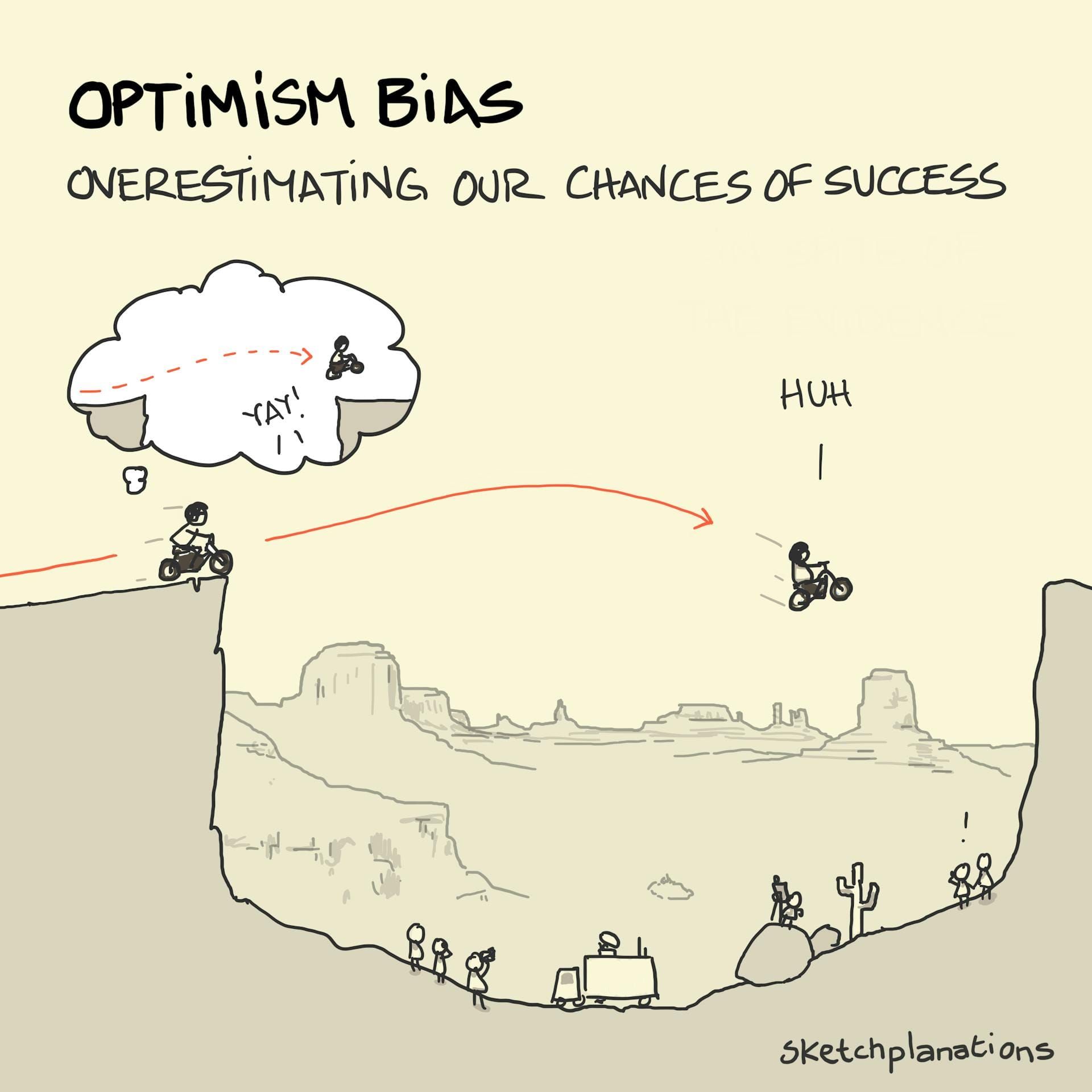
The "better-than-average effect" is a close relation of optimism bias, in which we overestimate the likelihood of positive events and underestimate the likelihood of negative events.3
Optimism bias frequently distorts risk perception. This distortion has negative consequences for how we perceive our personal vulnerability to climate-change risks compared to how we perceive the risk to others.
A meta-study (eighty-three data sets) focused on extreme weather events found we generally perceive the risks to ourselves to be lower than risks to others, regardless of objective reality, but overall perceptual distortion is nuanced.4 The closer and more individualized the “others” were (our immediate neighbours, say) compared to us, the less the distortion. The further in distance and more generalized others were, the more risk from climate change we perceived them to have.
The same study also found where large regions have more actual objective risks individuals in the region perceive less difference between their own risks and risks faced by others. People in the Asia-Oceania region, for example, who face higher objective risks, show less discrepancy between perceived and actual risks than do people in Europe, who face lower objective risks.
Other studies found differences in climate change risk perception depending on demographics. Women, younger, and poorer people perceive higher risk than men, older, and richer people.5
Why does misperception of climate change risk matter?
Public perception is important for supporting climate change mitigation and adaptation policies and strategies. If perception doesn’t match reality, policies may be weaker or non-existent. Necessary preventive actions may not be taken, leaving regions, groups and individuals more vulnerable.
Can changes in risk communication begin to address these distortions and mismatches?
Risk communication message framing is key.
A study in Vietnam found messaging that combined clear risk information with concrete advice on potential actions reduced the perception distortion.6
Another study found those who viewed climate change risks as a health and safety issue had a higher motivation to act. This implies communication that frames climate change as a personal health and safety risk would reduce the perception distortion and therefore increase support and action.7
A couple of studies followed up with listeners to a radio story of one man’s personal experience of climate change harm. The studies found positive changes in those listeners regarding beliefs in climate change and climate risk perception. Further, these changes were motivated by worry and compassion.8
Overcoming our cognitive biases to align our perceptions of the world with objective reality is always a challenge, but when it comes to climate change risk, how we talk about the issue is a good start.
Reading
- Berthet, Vincent, and Vincent de Gardelle. “The Heuristics-and-Biases Inventory: An Open-Source Tool to Explore Individual Differences in Rationality.” Frontiers in Psychology 14 (April 2023). https://doi.org/10.3389/fpsyg.2023.1145246.
- Wikipedia. “List of cognitive biases.” April 6, 2026. https://en.wikipedia.org/w/index.php?title=List_of_cognitive_biases&oldid=1347447680.
- Sharot, Tali. “The Optimism Bias.” Current Biology 21, no. 23 (2011): R941–45. https://doi.org/10.1016/j.cub.2011.10.030.
- Sandlund, Isak, Pär Bjälkebring, and Magnus Bergquist. “Meta-Analytical Evidence of a Self–Other Discrepancy in Climate Change-Related Risk Perceptions.” Nature Sustainability 9, no. 3 (2026): 377–84. https://doi.org/10.1038/s41893-025-01717-3.
- Paniello-Castillo, Blanca, Stefan Döring, Sarah Dryhurst, Giuliano Di Baldassarre, and Elena Raffetti. “Risk Perception of Climate Change and Global Crises: Influences of Socio-Economic Drivers and Political Orientations.” Humanities and Social Sciences Communications 12, no. 1 (2025): 967. https://doi.org/10.1057/s41599-025-05349-y.
- Ngo, Chinh Cong. Climate Change Risk Communication: How Message Frames Shape Perceptions of Risks and Efficacy, and Influence Behavioural Intentions to Climate Change Adaptation and Mitigation. December 14, 2021. https://doi.org/10.18174/554534.
- Mullins-Jaime, Charmaine, and Jan K. Wachter. “Motivating Personal Climate Action through a Safety and Health Risk Management Framework.” International Journal of Environmental Research and Public Health 20, no. 1 (2023): 7. https://doi.org/10.3390/ijerph20010007.
- Gustafson et al., “Personal Stories Can Shift Climate Change Beliefs and Risk Perceptions.” Communication Reports, Taylor & Francis Online. https://doi.org/10.1080/08934215.2020.1799049