Nuclear Energy 2: Hot Bananas and Radiation Risks
Unique dangers have created long-standing resistance to nuclear power.

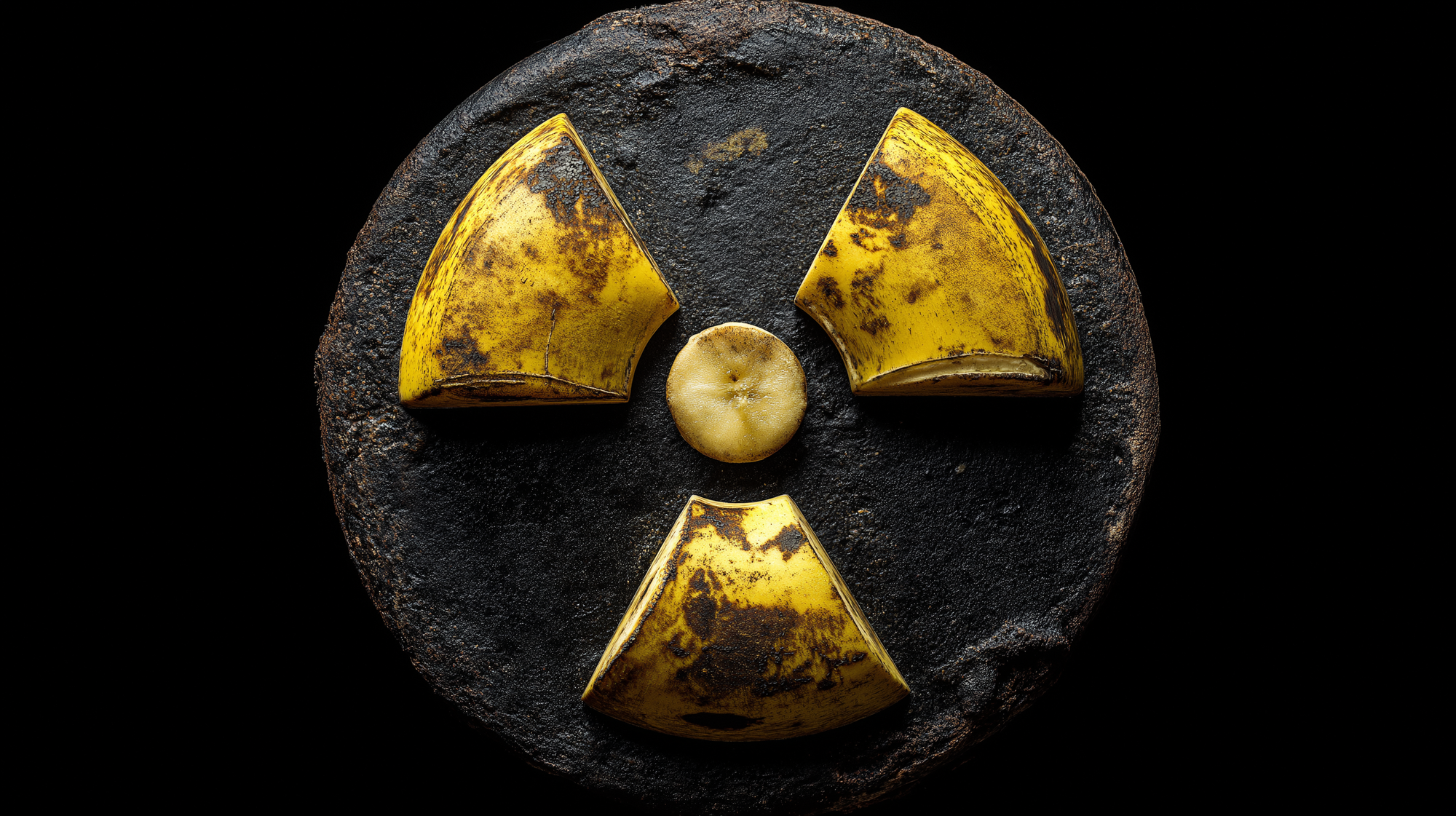
Before we look at the future of nuclear energy, we need to examine the real risks and concerns associated with nuclear power generation. These concerns fall into two broad categories: radiation and weapons proliferation.
Let’s start with radiation, which looms large in the public imagination. Radiation appears throughout the entire lifecycle of a nuclear power plant: during mining, enrichment, day-to-day reactor operations, for workers and nearby residents, and finally in the handling and disposal of waste. We covered accidents in Part 1, so here we focus on normal operations.
Radiation is a broad term that covers many phenomena, and understanding can quickly get technical. For our purposes, we focus on the subset relevant to nuclear power. First we need a measurement.
Rolf Sievert, a Swedish physicist and radiologist, pioneered the study of how radiation affects the human body. The unit named after him — the sievert (Sv) — represents one joule of radiation energy absorbed per kilogram of tissue, adjusted for biological effect. One sievert is a very high dose, so radiation is typically expressed in millisieverts (1 thousandth - mSv) or microsieverts (1 millionth - µSv).
Regulators limit public exposure to 1 mSv/year above natural background levels (averaged over five years), and limit occupational exposure for nuclear and medical workers to 20 mSv/year (averaged over five years, with no single year exceeding 50 mSv).1
Information is Beautiful has a wonderful chart that helps give you some idea of the relative dosages. It's worth a visit: https://informationisbeautiful.net/visualizations/radiation-dosage-chart/
For reference, here are some common radiation levels:
| Exposure Type | Typical Dose | Notes / Context |
|---|---|---|
| Eating 1 banana | 0.1 microsieverts | 1,000 microsieverts=1 millisievert |
| Natural background (global average) |
2.4 mSv/yr | From radon, cosmic rays, Earth, and internal sources |
| Radon in home (typical–high) | 1–10 mSv/yr | Depends on geology and ventilation |
| Cross-country flight | 0.05–0.1 mSv | Cosmic rays at altitude |
| Dental X-ray | 0.005 mSv | Negligible dose |
| Chest X-ray | 0.1 mSv | Routine diagnostic exposure |
| Mammogram | 0.4 mSv | Two-view screening |
| Chest CT scan | 7 mSv | Higher diagnostic detail |
Radiation is everywhere: we are all exposed to it continuously. Even bananas are radioactive. This is not a dietary concern — bananas contain a small, consistent amount of potassium-40. No need to adjust your smoothies. Scientists sometimes use the Banana Equivalent Dose (BED) as a humorous way to compare radiation exposures. For example: a dental X-ray is equivalent to 50 bananas and a flight from New York to London is 800 bananas.2
Mining and Fuel Preparation
Radiation levels throughout the nuclear fuel supply chain are well-characterized and kept within limits set by the International Commission on Radiological Protection (ICRP), using standard protective gear and procedures.3
Uranium-bearing minerals are typically found in sandstone, granites, and hydrothermal veins. Today, about half of global uranium production comes from in-situ leaching (ISL), where a liquid solution is pumped through sandstone formations to dissolve uranium underground. Whether ore is mined conventionally or recovered by ISL, it is crushed, chemically refined, dried, and oxidized into a concentrated powder — uranium oxide (U₃O₈) — known as yellowcake.
Yellowcake is mildly radioactive — above background — and safe to stand beside in sealed drums for limited periods of time. Exposure is governed by occupational standards. The main hazard is usually chemical, not radiological: like other heavy metals (e.g., lead), uranium oxide dust is toxic if inhaled, although chronic inhalation can also create long-term radiological hazards.
A series of chemical and physical steps converts yellowcake into fuel assemblies. These steps include enrichment to increase the proportion of U-235 (the isotope needed for reactor fuel) and transformation between solid and gas forms. Most reactors require fuel enriched to at least three to five percent U-235. The enriched material is typically formed into ceramic pellets, loaded into zirconium alloy tubes, filled with helium, and sealed. A new fuel rod's radioactivity can be handled with routine nuclear-industrial procedures.4
Inside the Reactor
Once in the reactor, fuel rods undergo controlled fission. U-235 nuclei absorb neutrons, become unstable, split into fission products, and release heat, radiation, and additional neutrons that sustain the chain reaction. Fission products such as iodine-131, cesium-137, and strontium-90 are commonly the highly-radioactive waste materials. Depending on the time since reactor shutdown, spent nuclear fuel is roughly one to ten million times more radioactive than fresh fuel.
After a few years – one to ten years depending on the reactor design – the fuel rods wear out. The U-235 drops down to less than one percent, pressure in the sealed rod rises, some of the fission products (xenon-135 and samarium-149) serve to “poison” the reactor by absorbing neutrons that would otherwise cause fission. Basically, the fuel becomes less efficient and needs to be replaced.
Freshly discharged spent nuclear fuel emits radiation at levels exceeding 10,000 sieverts per hour at close range. Even after years of cooling, the dose rates at the fuel surface remain rapidly fatal without shielding.5 Fuel rods are removed remotely and placed into deep cooling pools, where water both shields radiation and removes heat. There they remain for several years.
In Part 1 we discussed the significant nuclear power plant accidents. Chernobyl, the worst nuclear power plant accident in history, resulted in two deaths from the explosion and, within three weeks, a further twenty-eight deaths from ARS (acute radiation sickness) as a result of exposure to core debris, including spent fuel rods that were thrown around the site by the core explosion. Approximately five thousand excess cases of thyroid cancer — primarily among exposed children — have been attributed to radioactive iodine from Chernobyl. Most cases were successfully treated, though estimates of long-term mortality vary.
Another consequence of Chernobyl is the ongoing existence of an "exclusion" zone (initially approximately thirty kilometres in radius) around the explosion site. Evacuation of people in the zone started immediately close to the plant site and the nearby village of Pripyat, with over 100,000 evacuated in the first year and subsequently another approximately 230,000. Today no permanent residents, other than a few "self-settlers," live in the zone, which is roughly five thousand square kilometres in Ukraine and Belarus. While monitoring continues, no governments plan for a return of habitation, although some industrial applications are being considered (for example, solar farms).
Waste
At the end of the supply chain is the need to dispose of nuclear waste, which is one of the biggest unsolved problems of nuclear power generation. It, too, is a matter of radiation. Spent fuel rods are removed from a reactor and are highly radioactive, so are moved to concrete pools under forty feet of water, which both shields radiation and removes heat. The spent rods spend five to ten years in the pools. Once sufficiently cooled, the fuel is sealed in thick steel and concrete casks, each of which holds ten to fifteen tons of fuel. These casks are currently stored at the reactor sites and are designed to last 100+ years. There are currently no long-term storage sites to house this material. 6
Nuclear waste is such a pernicious problem because some of the fission materials last a very long time. The radioactive decay rates vary for the various residual fission materials, with some lasting for only days and others for centuries or millennia. The main radiation products, Cesium Cs-137 and Strontium Sr-90, give off gamma rays and heat ... the reason they are kept in cooling tanks for five to ten years. The half-life of these materials is thirty years: the radiative properties of half the material will decay away in that time. After three hundred years, most of the fission products are gone and radioactivity drops by 99%. What are left are called actinides: substances like plutonium Pu-239, americium (Am-241), neptunium (Np-237). While volumes are relatively small, some actinides will remain radioactive for more than 10,000 years.
Because of this, a permanent, deeply engineered geological repository is necessary. The world’s first such facility, Onkalo in Finland, is in a trial and commissioning phase. It is designed to isolate waste for 100,000 years.7 More such sites will be required.
An often-cited risk associated with nuclear energy is the potential for nuclear weapons proliferation. Most nuclear weapons require plutonium-239. Commercial power reactors do produce plutonium in spent fuel — typically on the order of 10 kilograms per tonne — but this plutonium is a mixture of isotopes, including significant amounts of Pu-240, that complicate weapons design and reduce reliability.
While reactor-grade plutonium is not ideal for weapons and would require extensive, sophisticated reprocessing and advanced engineering to use, it cannot be categorically dismissed as unusable. For this reason, international safeguards focus not only on material quantities but on controlling reprocessing technologies and fuel-cycle expertise.
In practice, weapons-grade plutonium has been produced almost exclusively in specialized reactors built for that purpose, not in commercial power reactors. As a result, the proliferation risk associated with civilian nuclear power generation is real but largely indirect — arising primarily from the spread of fuel-cycle capabilities rather than from the routine operation of power plants themselves.
Another risk associated with nuclear power is the potential of a radiological dispersal device (RDD), or “dirty bomb,” which would use a conventional explosive to spread radioactive material. Experts generally believe practical matters dictate such a device would use high-grade medical, industrial, or research material. Nuclear waste, they believe, is less likely to be used in a dirty bomb because it is bulky and difficult to obtain and handle. Even so, waste sites must still be protected from malicious actors and safeguarded carefully, because intentional dispersive damage to storage systems could have serious consequences: in other words, you don't have to move waste to make a dirty bomb. The U.S. Nuclear Regulatory Commission believes that for most plausible dirty‑bomb scenarios the primary danger would be social and psychological—fear, disruption, and economic impact—rather than prompt radiation casualties.8 That would not make an RDD any less effective.
Nuclear power stations are found in war zones, which points to another risk of physical damage to a plant that could lead to an accident. This situation exists today in Ukraine with fighting around the ZNPP (Zaporizhzhia Nuclear Power Plant), which has raised significant concern. ZNPP is a Ukrainian Nuclear power station that has six reactors, all of them now shut down. Fighting around the plant continues, with power outages being an ongoing problem. The International Atomic Energy Agency (IAEA) maintains a constant monitoring mission at ZNPP — something never done before at any nuclear plant in a conflict zone.9
Radiation and waste are at the heart of public concern about nuclear energy. The science shows that while radiation exists throughout the nuclear fuel cycle, exposures under normal operations are tightly regulated and kept well below harmful levels. The more difficult challenge is long-term waste: a relatively small but highly radioactive stream that requires engineered containment for centuries and, in the case of actinides, millennia. Proliferation remains a geopolitical issue, but commercial reactors play only an indirect role.
These risks are real, quantifiable, managed, and very different from the apocalyptic images that dominate public perception. Understanding them clearly is essential before we can meaningfully discuss nuclear energy’s future. That’s where Part 3 takes us: into the world of new reactor designs, walk-away-safe concepts, and the growing pressure of a rapidly-electrifying world.
Reading:
- “ICRPaedia.” Accessed November 24, 2025. https://icrpaedia.org/.
- “What Are the Requirements for Using the Radiation Warning Syminformbol?” HPS, n.d. Accessed November 20, 2025. https://hps.org/publicinformation/ate/q9921/.
- ICRP, The 2007 Recommendations of the International Commission on Radiological Protection, ICRP Publication 103 (Annals of the ICRP 37:2–4, 2007).
- “Nuclear Fuel Cycle Overview - World Nuclear Association.” Accessed November 20, 2025. https://world-nuclear.org/information-library/nuclear-fuel-cycle/introduction/nuclear-fuel-cycle-overview.
- International Atomic Energy Agency. Storage of Spent Nuclear Fuel. IAEA Safety Standards Series No. SSG-15. Vienna: IAEA, 2012.
- “Nuclear Fuel Cycle.” Text. IAEA, July 11, 2016. http://www.iaea.org/topics/nuclear-fuel-cycle.
- Prang, Allison. “The Climate Fix: Nuclear Waste Finds Its Forever Home.” Climate. The New York Times, March 14, 2025. https://www.nytimes.com/2025/03/14/climate/nuclear-waster-permanent-storage-finland.html.
- “Backgrounder on Dirty Bombs | Nuclear Regulatory Commission.” Accessed December 15, 2025. https://www.nrc.gov/reading-rm/doc-collections/fact-sheets/fs-dirty-bombs?utm_source=chatgpt.com.
- “Update 317 – IAEA Director General Statement on Situation in Ukraine.” Text. IAEA, September 30, 2025. http://www.iaea.org/newscenter/pressreleases/update-317-iaea-director-general-statement-on-situation-in-ukraine.