Burning Iron
Iron as a low-carbon energy carrier in a closed-loop cycle.

Much of the world's current energy needs are met by burning fossil fuels.
Seems blindingly obvious, but what exactly is "burning"?
Burning is essentially a high-speed chemical reaction (oxidation) in which the carbon and hydrogen present in the wood, coal, oil, or natural gas combine very rapidly with oxygen in the air, giving off heat and producing water and carbon dioxide (CO2) as end products. We want the heat. We don't want the CO2 but can't avoid it.
What if we could burn other stuff that didn't contain carbon to obtain useful heat without producing CO2?
Turns out we can, and that stuff is iron.
We can't just put a match to our cast iron stove and expect it to burn ... but grind iron into fine-enough powder, expose it to air, ignite it, and iron will burn. Burning iron this way gives off heat and produces iron oxides (rust) as an end product, but no CO2.
Iron is abundant, so potentially we could just mine it and burn it, as we do fossil fuels. However, iron is not found in a pure state in nature, being already oxidized in the form of iron ores (iron oxides). The process of extracting pure iron from iron ore is very carbon intensive, as we wrote about in our article on steel, so we wouldn't be any further ahead from a greenhouse gas perspective.
Iron can be used, however, as an energy storage and carrier in a closed-loop iron power-cycle where the iron oxides produced by the iron combustion process are collected and recycled back into iron. Recycling is accomplished by removing the oxygen (chemists call this "reduction"), yielding metallic iron again. The reduction process requires energy. The iron oxidation-reduction cycle can be low-carbon with iron as the energy storage and carrier if, and it's a big if, the reduction process uses renewable energy.1
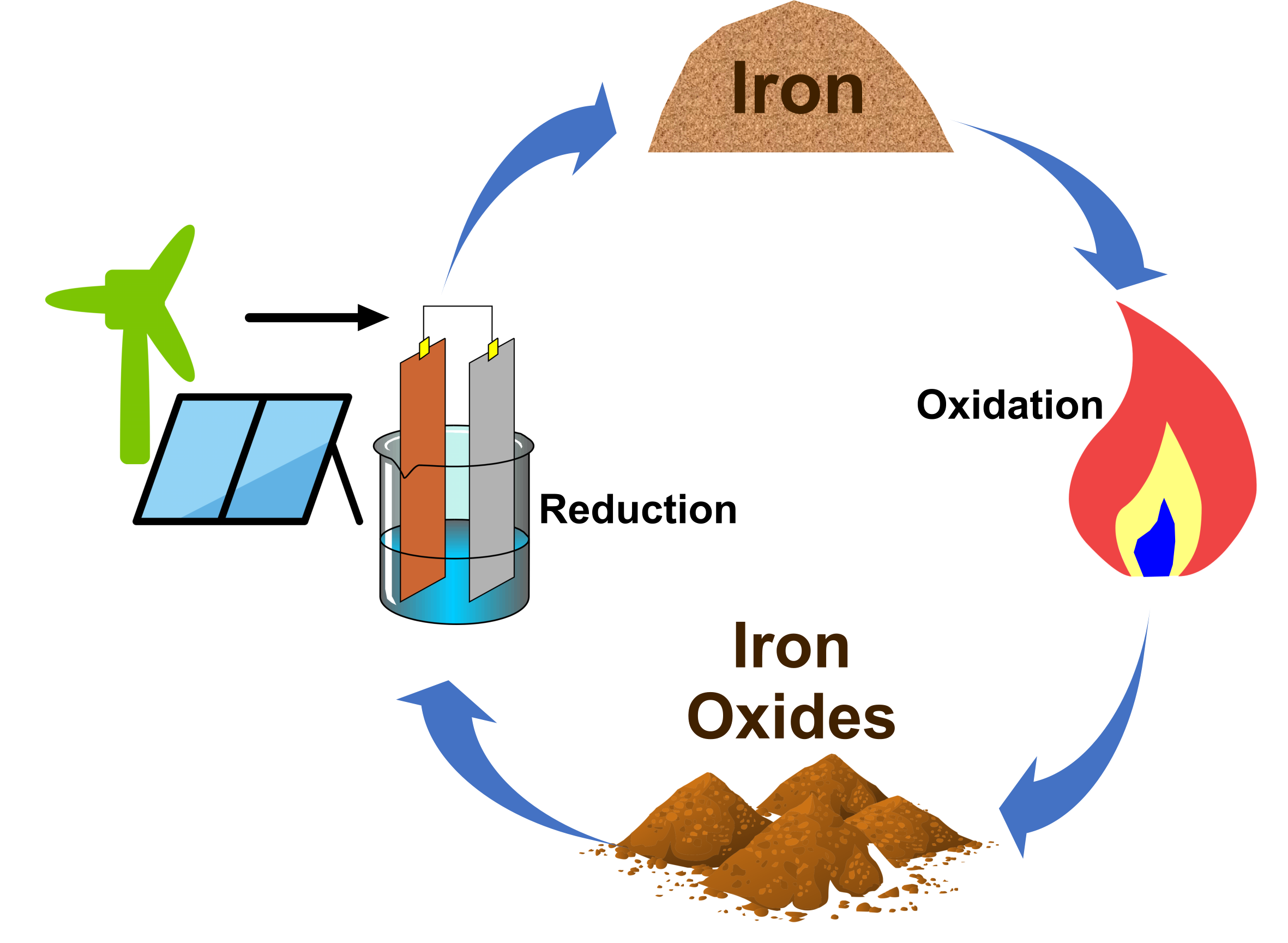
Iron oxide reduction can be done in two ways:
- Direct electrochemical reduction of iron oxides using renewable electricity. Of the various ways to do this, most research effort seems to be focused on electrolytic electrodeposition in an electrochemical cell, allowing for solid iron to be directly deposited on the cathode, where it can be harvested.2 Engineering details of the design and operation of these cells are critical to their efficacy and efficiency. In principle, this method allows for a simple materials loop.
- Thermochemical reduction using hydrogen as the reducing agent. The hydrogen chemically reduces iron oxides in two or three steps (depending on temperature of the reaction) in a high-temperature reactor, producing metallic iron and steam. The key to making this part of the process low-carbon is that the hydrogen has to be produced with renewable, so-called "green" hydrogen.3 As we noted in an earlier article, accessing sufficient green hydrogen at the scale and economic attractiveness required is still doubtful. In addition, hydrogen reduction of iron oxides requires a whole additional hydrogen value chain of electrolysis, compression, transport, storage, and handling.
Two other major question marks remain around using iron as a renewable energy carrier. The first is how many times iron can be recycled in this closed-loop process. In theory it should be infinite, but practical considerations around iron particle size may limit the number of cycles.4 The second is round-trip energy efficiency of the whole process ... that is, usable energy after the accumulated inevitable losses at each stage of the cycle. Preliminary estimates suggest the whole cycle may be no more than 23-38% efficient, depending on the reduction process.1
Here is a larger question. Since the whole point of trying to establish a closed-loop, low-carbon iron power cycle is that it is dependent on renewable electricity at its heart, why not just use that renewable electricity directly and skip all the complication that comes with using iron this way?
There are several potential reasons:
- Iron as an energy storage medium has relatively high energy-density by volume, especially compared to batteries.
- Iron and iron oxides are chemically stable, enabling long-term energy storage without losses, allowing the intermittent nature of renewables to look more like traditional steady grid-power sources.
- Iron and iron oxides have low toxicity, so they are safe to handle.
- Heat production from burning iron is a good match with many industrial processes that need high-temperature heat.
- It may be possible to convert existing coal-burning power plants to iron-burning, thereby re-using existing fuel transport and electricity distribution infrastructure.
Iron power cycle projects are moving out of academia into pilot projects in The Netherlands, Germany, France, and Canada.5
It remains to be seen what the carbon footprint of these iron power cycle projects turns out to be once they are up and running, and how the economics will play out. If the former is low enough and the latter is favourable enough, we may see a lot of burning iron in our future.
Reading
- P. Debiagi et al., "Iron as a Sustainable Chemical Carrier of Renewable Energy: Analysis of Opportunities and Challenges for Retrofitting Coal-Fired Power Plants," Renewable and Sustainable Energy Reviews 165 (September 2022): 112579, https://doi.org/10.1016/j.rser.2022.112579.
- Francisca Méndez Florido et al., "Direct Electrochemical Reduction of Iron Oxide for Metal Energy Storage - a Microfluidic Study on the Impact of Cell Design for Slurry Electrolysis," Fuel 415 (July 2026): 138291, https://doi.org/10.1016/j.fuel.2026.138291.
- N. C. Stevens et al., "Hydrogen Reduction of Combusted Iron Powder: Role of Water Vapor in Reaction Kinetics," Powder Technology 469 (February 2026): 121912, https://doi.org/10.1016/j.powtec.2025.121912.
- Willie Prasidha et al., "Exploring Consecutive Cycles of Iron Powder Combustion for Sustainable Thermal Energy," Combustion and Flame 283 (January 2026): 114582, https://doi.org/10.1016/j.combustflame.2025.114582.
- Prachi Patel, "New Iron Age: Metal Fuel Forges Ahead," Chemical & Engineering News, January 21, 2025, https://cen.acs.org/energy/iron-fuel-combustion-energy-heat/104/web/2026/08.