Reducing Carbon Dioxide Emissions from Shipping by Half
A ship-borne system employing accelerated weathering of limestone to capture carbon dioxide from exhaust gas is better and cheaper than land-based systems.
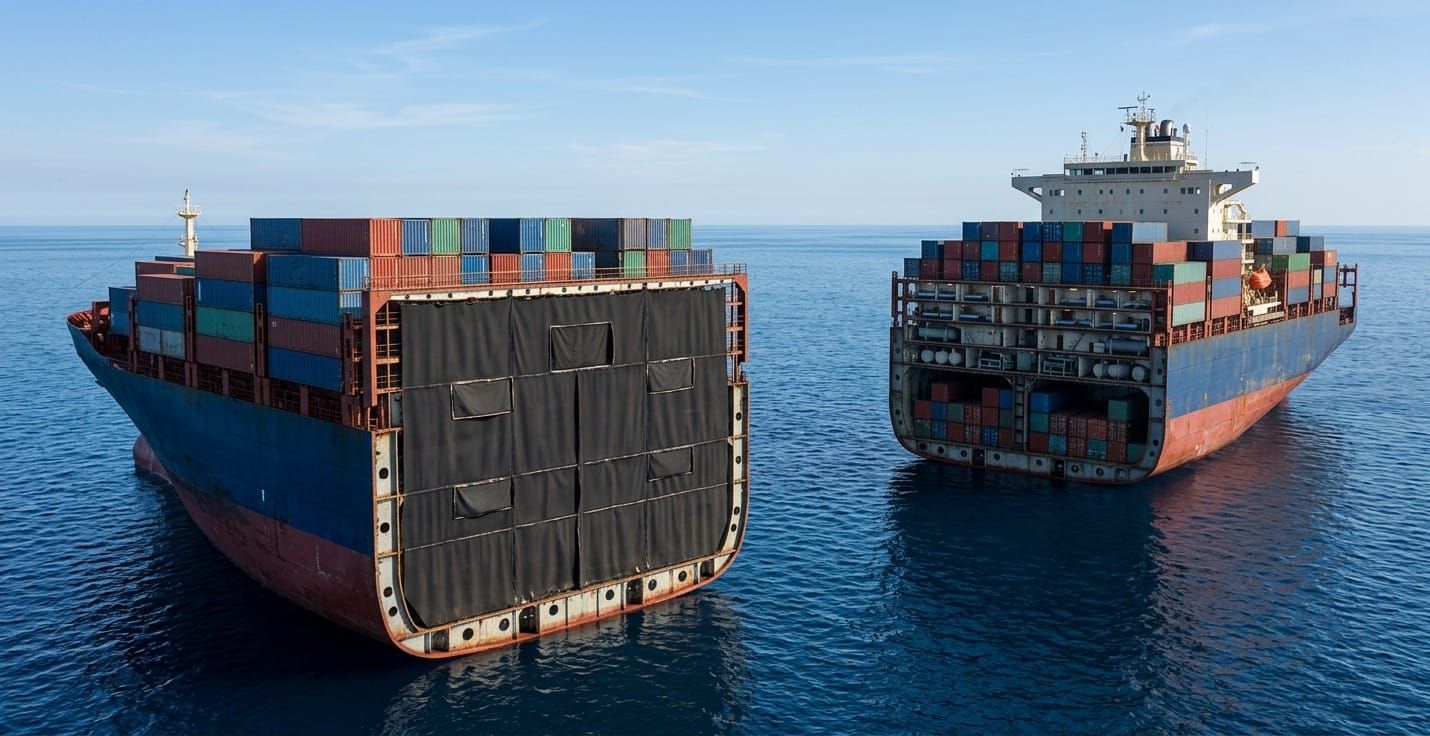
The recent and ongoing closure of the Strait of Hormuz to shipping highlights just how dependent the world is on ships to transport key commodities in addition to oil and Liquid Natural Gas (LNG). Availability of fertilizer is down 20% to 33% globally while agricultural products shipped to the Persian Gulf are down 50%.1 Rose George’s 2013 book, “Ninety Percent of Everything”, engagingly details just how and how much of the world’s goods are transported by ship at some point (no prize for guessing how much).2
Ships are overwhelmingly powered by diesel engines burning fossil fuels, with their consequent greenhouse gas (GHG) emissions accounting for about 3% of the global total.3 Renewable power alternatives to the diesel engine are not yet widely available. Even if they were, it would take a long time to replace the existing diesel-powered fleet. Finding technically-feasible and cost-effective ways to reduce CO2 emissions from existing ships has been challenging.
Now scientists at USC (University of Southern California) and Caltech have prototyped a method that could cut emissions from shipping by half. The method essentially mimics a naturally recurring geochemical reaction, but speeds it up.
To understand how it works, a little geochemistry review is in order.
Carbon dioxide in the atmosphere makes rainwater slightly acidic (carbonic acid). The carbonic acid reacts with some types of calcium-carbonate-bearing rocks, like limestone. The rock dissolves, locking up the carbon in the resulting bicarbonate ions, and producing some calcite. More CO2 in the atmosphere dissolves more rock. This rock-weathering is one of the natural processes (along with the marine carbon cycle) that keep the CO2 in the atmosphere relatively stable over the long term. These processes work on geological time scales, however: not fast enough to deal with the radical increase in atmospheric carbon added by human activity.
Other researchers have looked into speeding up the process by using ground-up limestone to capture carbon dioxide from industrial point-emission sources (such as power plant boiler flue gas) in a method known as accelerated weathering of limestone (AWL). The chemistry of AWL is straightforward. CO2 from the exhaust gas is initially dissolved into water. The acidified water then reacts with the limestone to form stable bicarbonate ions.
Applying AWL to land-based, ocean-side power plants faces technical and economic challenges. Getting the limestone to the plants requires transportation energy. Pumping energy is needed for the large volumes of sea water required. Slight alkalinity increases in discharge water could increase local concentrations unacceptably. Not all the dissolved CO2 remains in the seawater: some is degassed back to the atmosphere.4
The ship-based application of AWL proposed by the USC/Caltech scientists avoids or reduces the land-based problems. The system uses an onboard chemical reactor consisting of a series of absorption columns and dissolution tanks, which combine CO2 from the ship’s engine exhaust gas with seawater and limestone. Limestone could be procured from ports-of-call near limestone sources. A ship moving at fifteen knots speed effectively supplies the pumping power. Discharge water is mixed and distributed by the turbulent ship wake, eliminating local concentrations and reducing degassing. The slight residual alkalinity increase (less than 0.1%) might actually help reduce the increasing acidity of the oceans.5
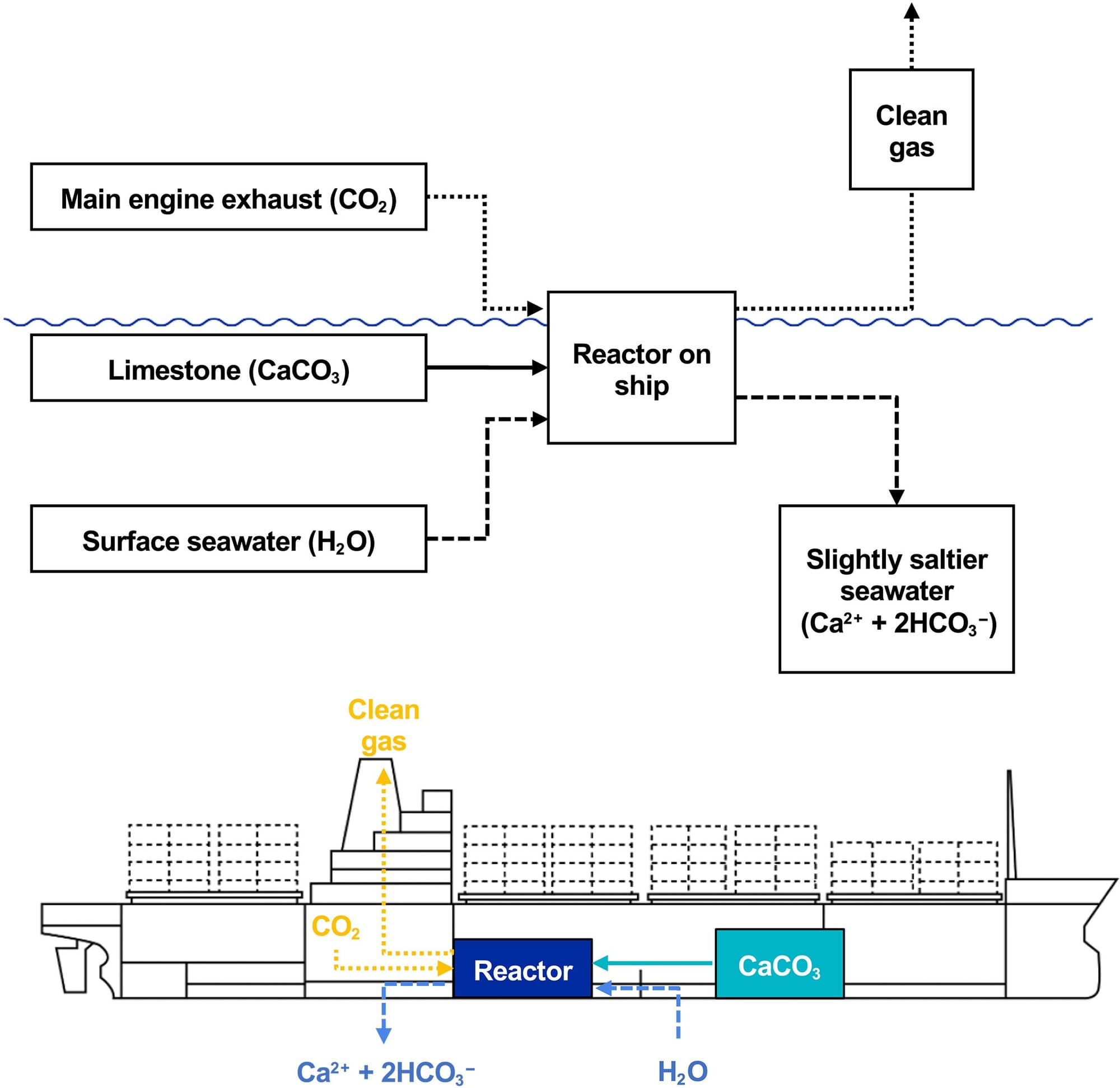
The end result? This ship-borne AWL system removes about half of the CO2 from the exhaust stream. We would wish that the system removed all of the CO2 ... but half, if the system can be implemented relatively quickly, is a good interim step.
The system is moving out of the lab into the design of a new working ship, a bulk carrier.6 Several design and validation steps must be accomplished before the ship actually sails, but this is a technology to watch.
Reading
- “Power BI Report.” https://datalab.wto.org/Strait-of-Hormuz-Trade-Tracker
- Rose George, “Ninety Percent of Everything.” https://www.rosegeorge.com/ninety-percent-of-everything
- World Economic Forum, “Decarbonizing the Maritime Industry with Emissions Tracking.” 02 May 2025 https://www.weforum.org/stories/2025/05/decarbonize-maritime-industry-real-time-emissions-tracking/
- Kirchner et al., “Carbon Capture via Accelerated Weathering of Limestone.” https://doi.org/10.1016/j.ijggc.2019.102855
- Dong et al., “Potential of CO2 Sequestration through Accelerated Weathering of Limestone on Ships.” https://doi.org/10.1126/sciadv.adr7250
- https://aureliadesign.nl/calcarea-and-aurelia-launch-collaboration-to-bring-ocean-based-carbon-capture-to-commercial-shipping/