Everybody comes to fight sparrows
If you subdue the Earth, it'll subdue you back.

First, a true story from Canada's prairies.
Many decades ago, a farm family felt overwhelmed by invasive house sparrows (Passer domesticus). The sparrows seemed to be everywhere. These introduced birds were "bad," thought the family, convinced that the non-native sparrows out-competed local songbirds and pushed other species off the farm.
Their son, who was nine at the time, was determined to help. Every night, the sparrows roosted noisily in the hay loft of a hip-roof barn. The son would take a flashlight, a BB gun, and his best friend — a skinny white cat — and together they would sit quietly in the hay loft, trying to solve the problem ... by spotlighting and shooting the sparrows. Nobody noticed any difference in the number of birds, but the cat definitely gained weight.
Conversely, the little boy grew visibly thin and tired-looking. He had stopped eating, seeming to lack an appetite for anything.
After some time, his parents discovered a small fire pit not too far back in the bush. He had, it seems, been joining the cat for the sparrow dinners. Unlike the cat, he had been cleaning the sparrows and stuffing them with wild leaves and grass before roasting them on a fire. As you might expect, he had to endure both a stern lecture and a stiff shot of worm medicine.
But he was neither alone nor the first in an effort to eradicate sparrows.
No warrior shall be withdrawn
Now, a true story from the far east.
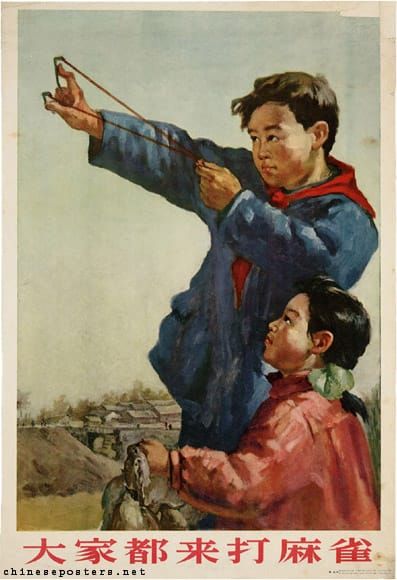
A few years earlier, in the late 1950s, the Chinese government had a very similar idea about Eurasian tree sparrows (Passer montanus), which were thought to compete with humans for grain and other seeds. As part of its "Four Pests Campaign," China encouraged its people to work methodically to eliminate all the Eurasian sparrows in particular regions. Extinction was the goal.
The Peking People's Daily phrased the effort in military language, and appealed not just to adults: school children over the age of five were marshalled to join the sparrow-cidal force, which Radio Peking put at 3,000,000 sparrow hunters:
“No warrior shall be withdrawn until the battle is won,” proclaimed the Peking People’s Daily. “All must join battle ardently and courageously; we must persevere with the doggedness of revolutionaries.” Into battle, thus exhorted, went the Chinese millions to wage war on the lowly sparrow.2
The events of 2025 and 2026 have granted us a more-cynical vantage: we understand only too well how far what's said publicly can land from the actual, objective truth. So you won't be surprised to discover that sloganeering and public spin distorted facts before, during, and after the sparrow campaign. It has been qualitatively described many times, and not always accurately.
In 1956, before the campaign,2 Chinese officials claimed that each sparrow would eat 4.5 kilos of grain a year (an exaggeration). And, like our prairie boy but on a grander scale, they were convinced that the sparrows could themselves be part of an everyday diet. The officials claimed that a million sparrows could feed 60,000 people (didn't happen, but people did starve to death instead).3, 4 In fairness, some Asian cuisines have folk recipes using sparrow meat, so the expectation wasn't entirely unfounded.5
Well-regarded and highly-cited recent research has managed to put some quantitative ecological and economic dimensions to what actually happened.6
The timing of the sparrow campaign couldn't have been worse. Agricultural and societal reforms, bad management, forced diversion of labour from agricultural to industrial production, and a fistful of other policy and tactical errors combined to create the Great Chinese Famine of 1959 to 1961, which killed an uncounted number of people (somewhere between fifteen and fifty-five million: here's that inaccuracy we mentioned).
The sparrow elimination campaign, begun in 1956, killed perhaps as many as two billion sparrows in a broad area of China within two years. The tree sparrows weren't precisely extinct, but were functionally missing from the ecosystem. Yes, the sparrows stopped eating grain ... but they also stopped eating a fair number of pests – notably locusts and plant hoppers – that attacked farm crops. On the leading edge of a famine, eliminating the birds that eat pests depressed crop yields by several percent more.
Whatever a sparrow eats in grain during the winter is a small toll for a gigantic service: pest control. Without the sparrows, enough crops failed to starve two million people to death and to prevent another 400,000 births. They were far better off with the sparrows.
Today, we are beginning to understand the concept of "ecosystem services" a bit better. Species obviously exist inside an ecology, as part of a balanced, homeostatic exchange. Each species contributes to the balance by preying on — and being prey for — other species. But, more than that, each species contributes services to the ecology as a whole: controlling pests, moving nutrients, creating soils, suppressing floods, mitigating droughts, managing and modifying climates in ways we don't always understand. That is, until those services are missing and something collapses.
You don't know what you've got 'til it's gone.
World sparrow day is March 20th each year.
Reading
- “Everybody Comes to Beat Sparrows | Chinese Posters | Chineseposters.Net.” Accessed April 6, 2026. https://chineseposters.net/posters/e12-901.
- “RED CHINA: Death to Sparrows.” Accessed April 6, 2026. https://time.com/archive/6800787/red-china-death-to-sparrows/.
- Frank, Eyal G. et al., “Campaigning for Extinction: Eradication of Sparrows and the Great Famine in China,” NBER Working Paper 34087 (Cambridge, MA: National Bureau of Economic Research, August 2025), https://climate.uchicago.edu/wp-content/uploads/2025/07/Campaigning-for-Extinction-Eradication-of-Sparrows-and-the-Great-Famine-in-China.pdf.
- “How the Persecution of Sparrows Killed 2m People.” The Institute for Climate and Sustainable Growth, n.d. Accessed April 6, 2026. https://climate.uchicago.edu/news/how-the-persecution-of-sparrows-killed-2m-people/.
- Dvorsky, George. “China’s Worst Self-Inflicted Environmental Disaster: The Campaign to Wipe Out the Common Sparrow.” Sec. Io9. Gizmodo, July 18, 2012. https://gizmodo.com/china-s-worst-self-inflicted-environmental-disaster-th-5927112.
- NamuWiki. “Sparrow Roast.” March 16, 2026. https://en.namu.wiki/w/%EC%B0%B8%EC%83%88%EA%B5%AC%EC%9D%B4. Not a Chinese recipe, but it suggests the necessary meat sparrows should be imported from China.