Carbon Competence
Climate change mitigation actions are not as effective as we think.

If you’re like me, you may not have come across the term "carbon competence" before. Curious about the term's origin, I found the concept first mentioned in a 2010 master's thesis, in the context of the project management skills necessary to achieve carbon reduction targets.1 Use of the term has largely been confined to academia until recently. In August 2026 an important study published in Nature Sustainability applied the concept more broadly to the capability of individuals in the general population to adopt actions that mitigate climate change.2
Before getting to what the study found, it's worth putting it into the context of individual versus societal responsibility for climate change. Public debate around the climate change crisis and solutions to it is often dominated by a focus on choices made by individuals. This focus has an insidious aspect. The unspoken implication is if causes, and therefore solutions, to the climate crisis arise largely as a result as a consequence of aggregate individual choice, then climate change is the individual’s fault because they are not making the correct choices. Further, it implies a moral or ethical failing on their part. Not only that, it lets societal institutions avoid acknowledging their responsibility and acting on it.
The fossil fuel industry plays its part in furthering this narrative. A Twitter poll a few years ago (when X was still Twitter) conducted by Shell, is a good example. The poll asked the question: "What are you willing to change to help reduce emissions?" It offered four alternatives, three of which had to do with personal choice. This is a classic tactic, employed by the tobacco industry and well-documented, to try to reframe public discourse in an attempt to shift responsibility to someone else, in this case, to us consumers.3
Notwithstanding the fact much of the causes of climate change are effectively beyond our individual control because of societal, institutional, and corporate choices, there are actions we can take as individuals.
If we want to do what we can, what actions have we taken and should we take? Which are the most effective? Which do we think are most effective versus which are actually most effective?
The Nature study of adults in the USA, mentioned above, set out to answer the questions in two ways. First, by looking at the prevalence of which of 34 possible actions people take compared to their effectiveness in mitigating greenhouse gases. Second, by looking at the difference between how effective people perceive those actions to be, in terms of greenhouse gas mitigation potential, and how effective those actions actually are.
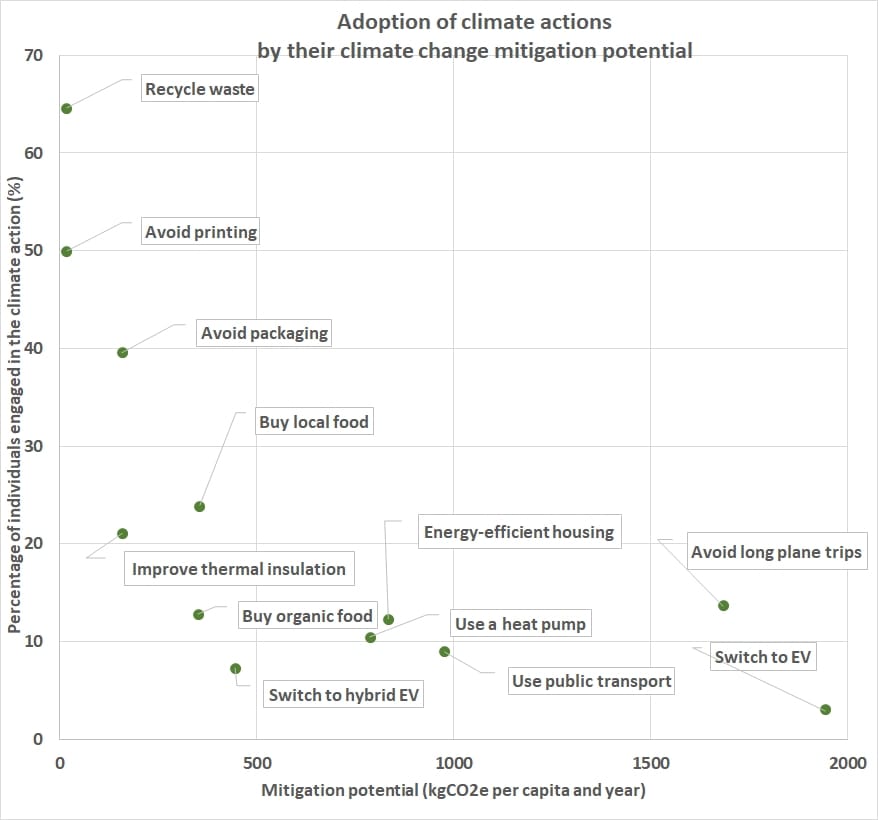
In the first comparison, the study found "Notably, most climate actions that an individual can adopt in the domain of consumption are of low-to-medium impact, whereas only a few actions are of high or very high impact."2 The result is most actions people take don't have a big impact. Figure 1 shows the percentage of people taking a representative dozen (out 34 potential) actions compared to their effectiveness.
The second comparison reveals most people's perception of the effectiveness of the actions they could take does not match the reality of the actual effectiveness of those actions. Generally, people overestimate how effective the actions they do or could take, and underestimate the effectiveness of actions they don’t take. For example, buying local food is perceived to have almost the same mitigation impact as switching to an electric vehicle (EV), when in fact switching to an EV has more than five times the impact.
The overall result is not a large difference in perceived effectiveness of all potential actions, when in reality there is a large difference. If perceived matched actual, the actions plotted in Figure 2 would be located along the diagonal heavy dashed line, instead of roughly clustering along a horizontal band.
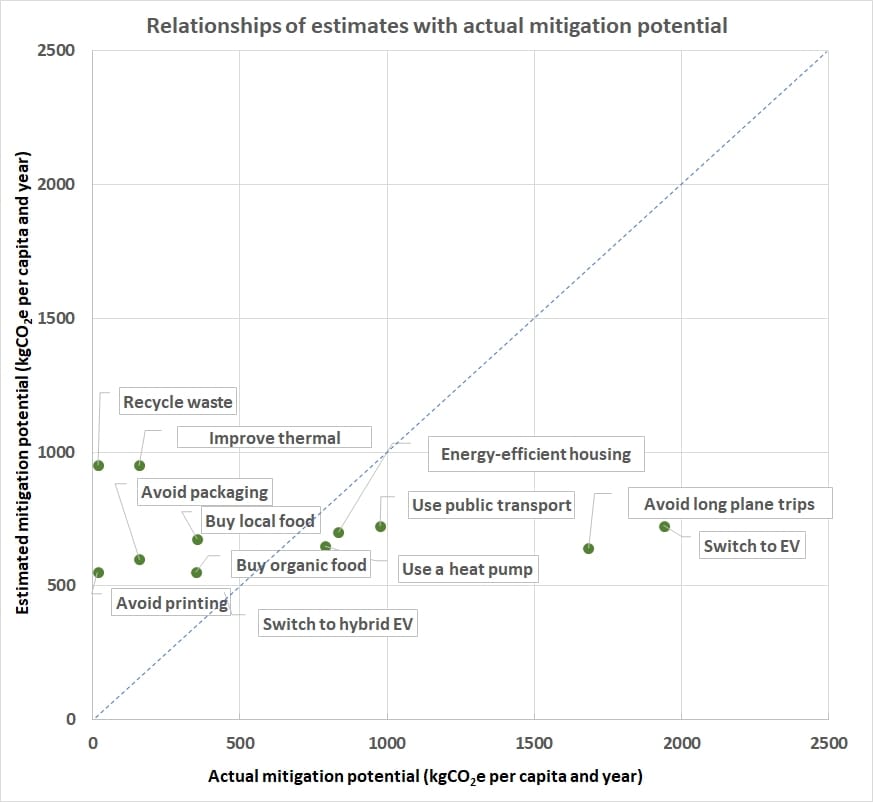
In the study's terms, when our perceptions don't align with reality regarding individual actions to mitigate climate change, that is low carbon competence.
Why is our carbon competence so low?
The study looked at possible reasons and three types stood out.
It turns out most of us, when confronted with uncertainty or lack of specific knowledge, rely on a kind of rule-of-thumb to make judgments (psychologists call this heuristics). We employ two types of heuristics in this area.
First is the ease with which an action can be retrieved from memory. Familiarity with actions causes us to overestimate their effectiveness. The second is motivated reasoning, which is when we likely over-estimate the efficacy of the actions we have taken compared to those we haven't. Motivated reasoning is also when we place more reliance on actions that confirm our worldview and self-image.
The third factor contributing to low carbon competence is numeracy, or lack of it. The better we understand numbers associated with climate actions, the more accurate our estimates are.
Of course these are average conclusions on reasoning, and the study found a great deal of variance between individuals.
The study also tested some interventions in a survey setting to see if accuracy of estimated mitigation actions could be increased. It was not clear which of those interventions, or others not tried, would be most effective. Nor was it entirely clear from the study how increasing accuracy of perception about the effectiveness of potential climate change actions would change behaviours.
It does seem clear that low carbon competence is a problem that needs addressing, a problem we will no doubt hear more about.
Reading
- Malik, K., Carbon Competence Measurement Model, 2010, https://pure.manchester.ac.uk/ws/files/34317231/FULL_TEXT.PDF
- Mario Herberz et al., “Psychological Barriers to Improving Carbon Competence,” Nature Sustainability, August 3, 2026, 1–10, https://doi.org/10.1038/s41893-026-01900-0.
- Supran, Geoffrey, and Naomi Oreskes. “Rhetoric and Frame Analysis of ExxonMobil’s Climate Change Communications.” One Earth 4, no. 5 (2021): 696–719. https://doi.org/10.1016/j.oneear.2021.04.014.