Suck greenhouse gases in. Push electricity out!
Now THAT is some high-karma deep breathing.

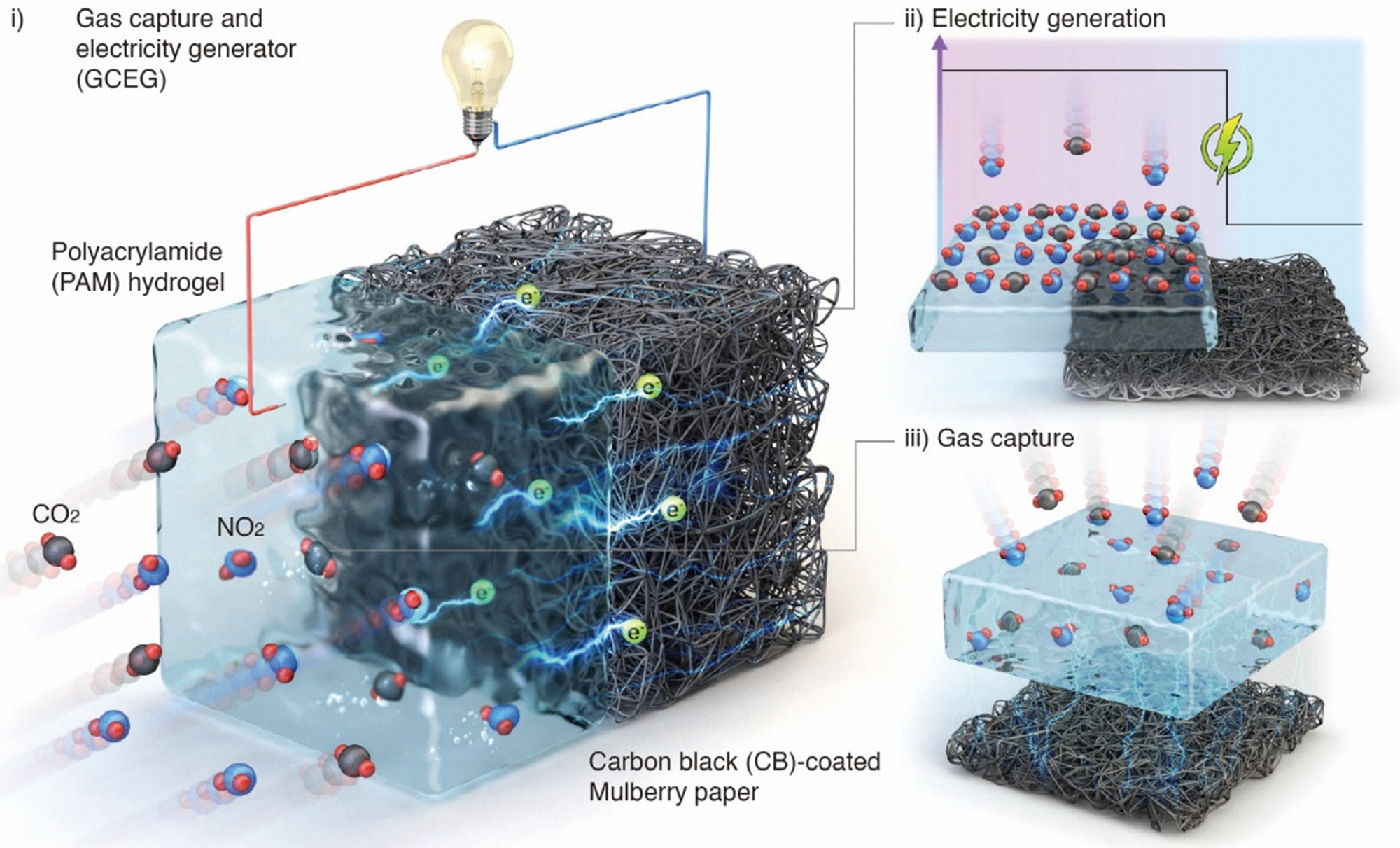
OK, it's not REALLY breathing. But a small-scale proof-of-concept demonstration of a passive device that captures carbon dioxide and nitrogen compounds at the same time as it generates electricity ... well, that's just plain exciting.
True to form, the scientists have come up with an initialism to describe the device: GCEG ... Gas Capture and Electricity Generator. (Some marketing type really should start a "Naming Stuff Basics for Nerds" class. Lots of these acronyms are really clunky ... this one included.)
Here's the scoop, though. In a just-published (and peer reviewed) article1, a Korean research group gives us a recipe that looks somewhat like this:
- Take some mulberry paper
- Coat it with carbon black
- Asymmetrically dip-coat the paper with a special hydrogel (think: extremely unsatisfying Jell-O) and/or an amine solution (made from ammonia)
- Connect a bunch of these strips in parallel and in series until you get the voltage and amperage you want
- Hook it up to something that can use electricity
- Watch carbon dioxide and various nitrogen-oxygen compounds get sucked up as your device does its work
The researchers were able to adjust the amounts of coatings on the mulberry paper to tune the sample to adsorb different amounts of CO2 or NO2. One .9 gram sample, tuned for carbon-dioxide, was able to uptake roughly half a litre of CO2.
Were the scientists able to power real, useful devices with this little trick? Yep, you bet. They powered a digital clock with a little cluster of mulberry paper ... and then they powered an internet-of-things style remote sensor, which they connected successfully to a tablet.
Here's the key point: because the device generates power, it is an entirely different class of carbon capture and storage.
One of the big problems so far with carbon capture is that it TAKES energy to run: so if you want to capture the harmful gases from fossil fuel, you need MORE energy to do that. That aspect of the whole carbon-capture approach really drops the practical miles-per-gallon rating of any vehicle: you need to run a big, power-sucking, background factory just to keep the automobile fuel from baking the planet. And then the carbon emissions from the factory need to be sequestered ... and so on. There was a carbonaceous old lady who swallowed a fly.
But a greenhouse-gas-capturing device that makes power ... well, it simply flattens out the slippery sequestration slope.
Oh ... one more thing. The process is in theory reversible: once it's saturated with greenhouse gases, you should be able to run it "backwards" by putting power into it, and it will release the gases for use or storage. (Nobody knows yet how many times it can be re-used.)
Once you are thinking in this way, you can imagine a car that vacuums up greenhouse gases while you drive it around, and then releases the gases into a collector when the car recharges. (Don't get too excited ... nobody has suggested this particular implementation will do something like that. But perhaps a distant descendant of it might.)
Will this remain a bench demonstration, a curiosity?
Maybe. But it's certainly the right kind of thinking.
Reading
- Yun, Tae Gwang, Yejin Lee, Joonchul Shin, et al. “Electrical Power Generation from Asymmetric Greenhouse Gas Capture.” Energy & Environmental Science 19, no. 7 (2026): 2149–60. https://doi.org/10.1039/d5ee06789h.